The “Smirk seen ’round the world” Updated 7/28/2020
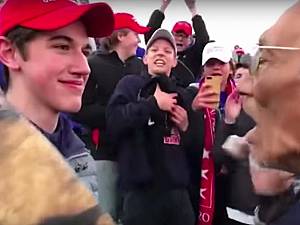
sandmannUpdate: Most of what’s below was posted January 2019. Since then, the boy in the left of the image filed defamation lawsuits against several news agencies and a few of them have settled.  Here are a couple of articles about those lawsuits and their resolution. This topic also fits well with the new course concepts around knowledge and knower, knowledge and technology, and knowledge and politics.

CNN Settles Lawsuit Brought by Covington Catholic Student Nicholas Sandmann (1/7/2020)

Numerous national media outlets painted Sandmann and his classmates as menacing — and in some cases racist — after an edited video emerged of Sandmann smiling, inches away from the face of Nathan Phillips, an elderly Native American man, while attending the March for Life on the National Mall. A more complete video of the encounter, which emerged later, showed that Phillips had approached the Covington students and begun drumming in their faces, prompting them to respond with school chants.

https://www.nationalreview.com/news/cnn-settles-lawsuit-brought-by-covington-catholic-student-nicholas-sandmann/

And another from 7/24/2020

https://thehill.com/homenews/media/508905-nicholas-sandmann-announces-settlement-with-washington-post-in-defamation

Interesting situation from a TOK perspective. Below is a collection of articles about the topic. They raise a lot of interesting questions about how we acquire knowledge and the relationships among the various ways of knowing. It also lends itself to ask about the primacy of some WOKs over others.


Download Lesson plan on “the smirk”

Download smirk articles handout

TOK Day 31 (daily student worksheet)

What’s also interesting is how impactful the image was. The image seemed to be a perfect representation of how many people view the current moment in the United States. It fit perfectly into prior assumptions about the world and spoke to a deeper truth. Interpreting and explaining this image!and fitting it into preexisting mental schema seemed pretty easy.

Once more and more videos started to emerge and the greater context became known, there were some interesting developments. Some people Continue reading “The “Smirk seen ’round the world” Updated 7/28/2020″

Twitter aims to limit people sharing articles they have not read

The problem of users sharing links without reading them is not new. A 2016 study from computer scientists at Columbia University and Microsoft found that 59% of links posted on Twitter are never clicked.

Twitter’s solution is not to ban such retweets, but to inject “friction” into the process, in order to try to nudge some users into rethinking their actions on the social network. It is an approach the company has been taking more frequently recently, in an attempt to improve “platform health” without facing accusations of censorship.

https://www.theguardian.com/technology/2020/jun/11/twitter-aims-to-limit-people-sharing-articles-they-have-not-read

Genocide denial gains ground 25 years after Srebrenica massacre

What is the relevance of historical knowledge? How does the present affect our views on the past?

Related: “Villain or hero? Sarajevo is split on archduke’s assassin Gavrilo Princip”

With survivors and perpetrators living side by side, and given the country’s divided politics, it is hard to imagine closure and reconciliation coming soon…

Schooling, like so much in Bosnia, is still divided along ethnic lines. Pupils are split into separate classes for “national subjects” such as history, and while the Bosniak textbooks cover the genocide, the Serb textbooks gloss it over. There is little hope of a unified curriculum in the country in the foreseeable future. “The main nationalist parties that continue to benefit from social division have no interest in changing a divisive status quo,” said Valery Perry, of the Democratization Policy Council in Sarajevo.

https://www.theguardian.com/world/2020/jul/10/genocide-denial-gains-ground-25-years-after-srebrenica-massacre


Hydroxychloroquine and the Political Polarization of Science

How a drug became an object lesson in political tribalism.

Why are we seeing the polarization over hydroxycholorquine, then, in spite of the serious consequences? The explanation may lie in the kind of information available to the public about COVID-19, which differs importantly from what we see in other cases of polarization about science. When it comes to the health effects of injecting disinfectants, there is no uncertainty about the massive risks. And for that reason, we don’t expect polarization to emerge, even if Trump suggests trying it. But even the best information about COVID-19 is in a state of constant flux. Scientists are publishing new articles every day, while old articles and claims are retracted or refuted. Norms of scientific publication, which usually dictate slower timeframes and more thorough peer review, have been relaxed by scientific communities desperately seeking solutions. And with readers clamoring for the latest virus news, journalists are on the hunt for new articles they can report on, sometimes pushing claims into prime time before they’ve been properly vetted.

https://bostonreview.net/science-nature-politics/cailin-oconnor-james-owen-weatherall-hydroxychloroquine-and-political

After the publication of this article, there was a retraction of a high profile study that suggested hydrochloroquine would lead to increased mortality and was ineffective as a treatment for covid-19.

All of this happened in the hyperpolarized context of American politics, referred to in the article above, in which even scientific truth bent around President Trump’s words.

https://www.npr.org/sections/coronavirus-live-updates/2020/06/04/870022834/authors-retract-hydroxychloroquine-study-citing-concern-over-data

American history textbooks can differ across the country, in ways that are shaded by partisan politics.

The latest in a never ending series of discussions about the nature of history textbooks and the politics that play into what students learn about. This article does a good job surveying differences more than making larger points about the nature of history but still worthwhile. Here are more links to more articles about controversies over history textbooks.

“At the end of the day, it’s a political process,” said Jesús F. de la Teja, an emeritus professor of history at Texas State University who has worked for the state of Texas and for publishers in reviewing standards and textbooks.

The differences between state editions can be traced back to several sources: state social studies standards; state laws; and feedback from panels of appointees that huddle, in Sacramento and Austin hotel conference rooms, to review drafts.

How should we talk about what’s happening to our planet?

Interesting article connecting the issue of language and climate change. This also gets at the fact that we don’t always communicate what we think we are and that different groups of people communicate differently. Frank Luntz, discussed below, often uses the adage: It’s not what you say, it’s what people hear.

The science community is supposed to interpret for the rest of us, but its dialect does not always pack rhetorical oomph. “I didn’t realize that pointing to a climate graph I think is the Rosetta stone — people don’t see it the way I see it,” says Brenda Ekwurzel, director of climate science for the Union of Concerned Scientists. “We as humans don’t experience an exponential curve viscerally, in our gut.”

https://www.washingtonpost.com/lifestyle/style/how-should-we-talk-about-whats-happening-to-our-planet/2019/08/26/d28c4bcc-b213-11e9-8f6c-7828e68cb15f_story.html

More on Luntz

Frank Luntz is a popular American pollster but also famous for helping the Republican Party hone its messaging and use of language in the 1990s and 2000s. He authored a famous memo on messaging the “War on Terror.” One can argue with the ethics of what he did (intentionally tying 9/11 and Iraq in people’s minds without ever explicitly making the connection for example) but his work was devastatingly effective. This memo made for much better discussion teaching TOK 10 years ago but I think is very interesting to still study.

Download Luntz Memo On Terrorism

Image of Luntz now discussing messaging on discussing climate change.

The “Smirk seen ’round the world”

sandmannInteresting situation from a TOK perspective. Below is a collection of articles about the topic. They raise a lot of interesting questions about how we acquire knowledge and the relationships among the various ways of knowing. It also lends itself to ask about the primacy of some WOKs over others.


Download Lesson plan on “the smirk”

Download smirk articles handout

TOK Day 31 (daily student worksheet)

What’s also interesting is how impactful the image was. The image seemed to be a perfect representation of how many people view the current moment in the United States. It fit perfectly into prior assumptions about the world and spoke to a deeper truth. Interpreting and explaining this image!and fitting it into preexisting mental schema seemed pretty easy.

Once more and more videos started to emerge and the greater context became known, there were some interesting developments. Some people Continue reading “The “Smirk seen ’round the world””