The Blind Men and the Elephant
September 30, 2018
When students come into Dan Levitin’s lab, he spends most of his time trying to teach them that they don’t know everything they think they do. “Knowledge can only be created in an environment where we’re open to the possibility that we’re wrong,” he says. Levitin shares his humble opinion on the best way to help students.
Human cleverness arises from distributing knowledge between minds, making people think they know more than they do
The hive mind, with its seamless interdependence and expertise-sharing, once helped humans hunt mammoths and now sends them into space. But in politics it causes problems. Using a toilet without understanding it is harmless, but changing the health-care system without understanding it is not. Yet people often have strong opinions about issues they understand little about. And on social media, surrounded by like-minded friends and followers, opinions are reinforced and become more extreme. It is hard to reason with someone under the illusion that their beliefs are thought through, and simply presenting facts is unlikely to change beliefs when those beliefs are rooted in the values and groupthink of a community.
https://www.economist.com/books-and-arts/2017/04/08/youre-not-as-smart-as-you-think-you-are
The quote, “The map is not the territory,” demonstrates a profound thought, and also a useful prompt for the TOK class. Before getting into connections between the quote and idea of models and metaphors, I wanted to put together a lesson on NYC subway maps (my school is in NYC). While doing so, I came across a bunch of different, and lovely, maps, each with its own representation of “reality.”
Download handout: NYC Map Handout
Click each image for a full size file.
1. Modern Day Subway Map
This is the map you see posted on the trains and subway platforms.

2. “Accurate Subway Map”
This map includes more accurate representations of distance and other features. Notice also it is more accurately oriented according to a traditional North-South map axis. The one above unintentionally (intentionally?) reorients the map around Manhattan.

3. NYC Station Map
This map focuses on the subway lines themselves and erases all other features.

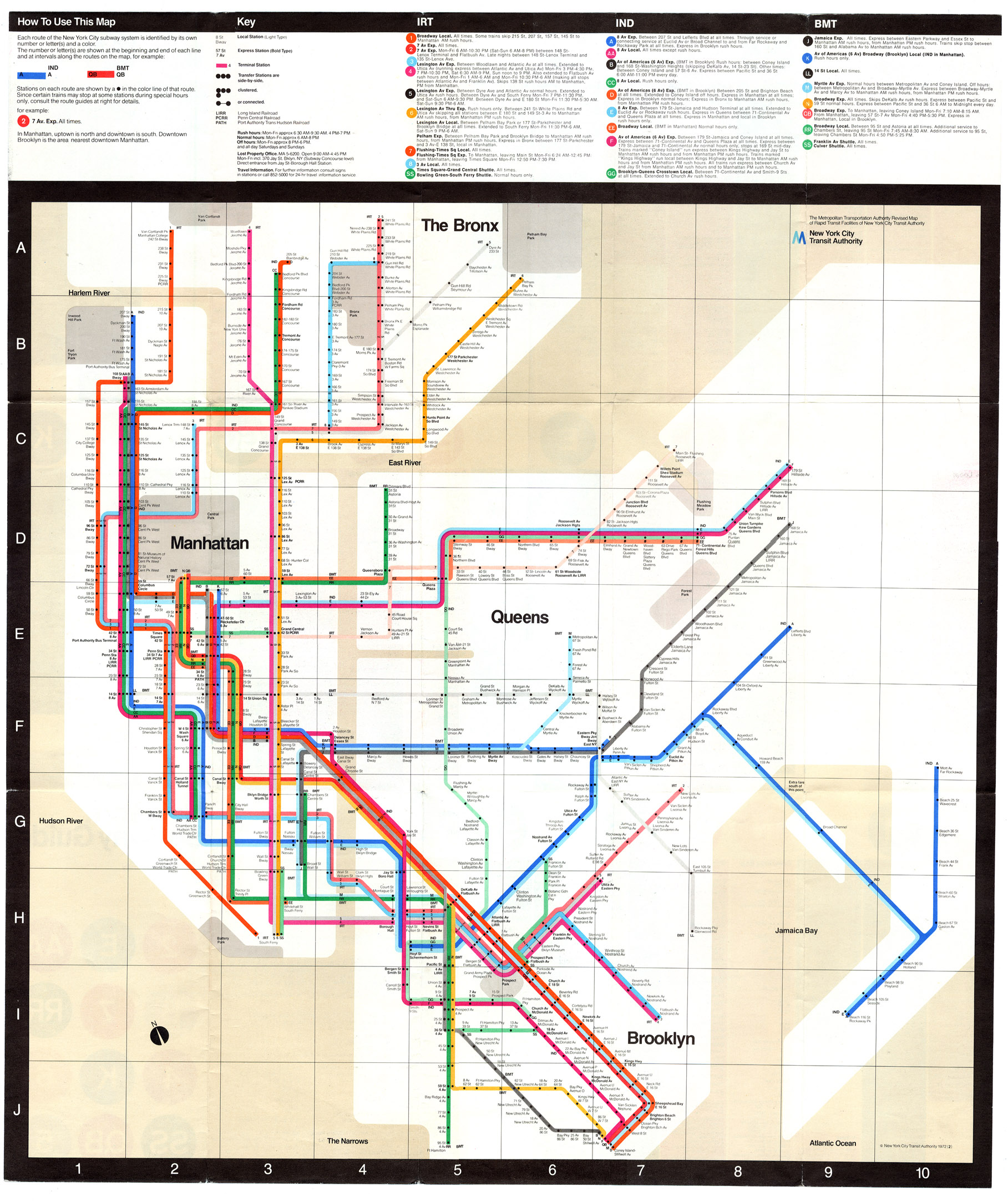
4. 1972 Massimo Vignelli Map
Much has been written about this map and the response it got. It put into practice the design principles (started in the London Underground Map designed by Harry C. Beck) that are used in many of the world’s systems. This map, though, did not receive a particularly positive reaction and was soon abandoned.
This site will morph the subway map into the actual geographic map for various metros around the world including New York. Really cool.
If you’re interested in this topic, you can find a lot more maps and more information at: https://www.nycsubway.org/wiki/New_York_City_Subway_Track_Maps (Click on the “Maps” tab at the top of that page).
In this 5 minute clip, from the Joe Rogan podcast, Neil deGrasse Tyson discusses his idea of the three different kinds of “truth.” It’s an interesting discussion on the definition of the word but also the implications of how we use words. Short enough to be interesting but not so long as to be tedious. For a tedious conversation on truth, see the previous post on the conversation between Sam Harris and Jordan Peterson.
I linked the video at the start of the relevant conversation.
Below is just the audioclip that you can stream just the audio if youtube is blocked and download below that if you just want the mp3 file.
We spent two hours debating what it means to say that a proposition is (or seems to be) “true.” This is a not trivial problem in philosophy. But the place at which Peterson and I got stuck was a strange one. He seemed to be claiming that any belief system compatible with our survival must be true, and any that gets us killed must be false.
https://samharris.org/speaking-of-truth-with-jordan-b-peterson/
Often, the conversation around gun violence becomes a conversation around political identities and ideologies rather than one about truth and how we arrive at it. This website is interesting in that it focuses on what we know through science. It uses appropriate, often cautious, language to come to its conclusions. The site is worth exploring. The table below summarizes the meta analysis of existing research done by the Rand Corporation. Click through the image to find the appropriate page. You can click in the table to see what research and evidence there is to support conclusions about efficacy.

Here is a link to the main page. Worth exploring for those curious about gun policy but also as an interesting case study on the use of the scientific method to help us understand and evaluate a problem in society.
https://www.rand.org/pubs/research_reports/RR2088.html
First, we need to distinguish attempts to manipulate and influence public opinion, from actual voter persuasion. Repeatedly targeting people with misinformation that is designed to appeal to their political biases may well influence public attitudes, cause moral outrage, and drive partisans further apart, especially when we’re given the false impression that everyone else in our social network is espousing the same opinion. But to what extent do these attempts to influence translate into concrete votes?
“How easy is it to change people’s votes in an election?
“The answer, a growing number of studies conclude, is that most forms of political persuasion seem to have little effect at all.”
Currently, thousands of plants and animals grown and raised in the United States have been genetically modified in some way. Since the beginnings of agriculture and animal husbandry, humans have been manipulating the genetics of plants and animals but what’s different now is that we have the ability to successfully and effectively splice genes from one species into another. Sometimes DNA from a bacterium has a property that is effective when added to the genome of corn. Once this DNA is added, the corn is considered “genetically modified” or a genetically modified organism (GMO). (Click here for more information on what a GMO is)
Rigorous scientific studies have consistently shown that GM foods are as safe to consume as their non GM counterparts however fears about their safety persist. Why is that? To get to the heart of the issue we have to examine the role of language in our acquisition of knowledge, the relationship between emotion and reason when making decisions about our health, and standards of good science.
 TOK Topics