When Choosing What To Believe, People Often Choose Morality Over Hard Evidence

What happens when moral beliefs collide with documented evidence? For many people, it means doubling down on whichever compliments their worldview.

The authors offer two models for this system of rationalization. In the first model, moral concerns shift the correct criteria for making judgmentsfor instance, by lowering the amount of hard evidence deemed sufficient to justify a particular belief. “Morality changes how much evidence [people] consider to be required to hold [a particular] belief in an evidentially-sound way,” the authors write.

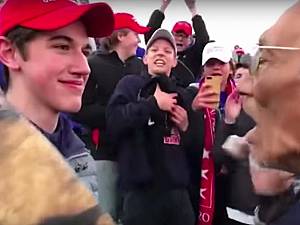
The “Smirk seen ’round the world” Updated 7/28/2020

sandmannUpdate: Most of what’s below was posted January 2019. Since then, the boy in the left of the image filed defamation lawsuits against several news agencies and a few of them have settled.  Here are a couple of articles about those lawsuits and their resolution. This topic also fits well with the new course concepts around knowledge and knower, knowledge and technology, and knowledge and politics.

CNN Settles Lawsuit Brought by Covington Catholic Student Nicholas Sandmann (1/7/2020)

Numerous national media outlets painted Sandmann and his classmates as menacing — and in some cases racist — after an edited video emerged of Sandmann smiling, inches away from the face of Nathan Phillips, an elderly Native American man, while attending the March for Life on the National Mall. A more complete video of the encounter, which emerged later, showed that Phillips had approached the Covington students and begun drumming in their faces, prompting them to respond with school chants.

https://www.nationalreview.com/news/cnn-settles-lawsuit-brought-by-covington-catholic-student-nicholas-sandmann/

And another from 7/24/2020

https://thehill.com/homenews/media/508905-nicholas-sandmann-announces-settlement-with-washington-post-in-defamation

Interesting situation from a TOK perspective. Below is a collection of articles about the topic. They raise a lot of interesting questions about how we acquire knowledge and the relationships among the various ways of knowing. It also lends itself to ask about the primacy of some WOKs over others.


Download Lesson plan on “the smirk”

Download smirk articles handout

TOK Day 31 (daily student worksheet)

What’s also interesting is how impactful the image was. The image seemed to be a perfect representation of how many people view the current moment in the United States. It fit perfectly into prior assumptions about the world and spoke to a deeper truth. Interpreting and explaining this image!and fitting it into preexisting mental schema seemed pretty easy.

Once more and more videos started to emerge and the greater context became known, there were some interesting developments. Some people Continue reading “The “Smirk seen ’round the world” Updated 7/28/2020″

Twitter aims to limit people sharing articles they have not read

The problem of users sharing links without reading them is not new. A 2016 study from computer scientists at Columbia University and Microsoft found that 59% of links posted on Twitter are never clicked.

Twitter’s solution is not to ban such retweets, but to inject “friction” into the process, in order to try to nudge some users into rethinking their actions on the social network. It is an approach the company has been taking more frequently recently, in an attempt to improve “platform health” without facing accusations of censorship.

https://www.theguardian.com/technology/2020/jun/11/twitter-aims-to-limit-people-sharing-articles-they-have-not-read

Making people aware of their implicit biases doesn’t usually change minds. But here’s what does work

Click here for other articles tagged, “Implicit Bias”

Do the diversity or implicit bias training programs used by companies and institutions like Starbucks and the Oakland Police Department help reduce bias?

I’m at the moment very skeptical about most of what’s offered under the label of implicit bias training, because the methods being used have not been tested scientifically to indicate that they are effective. And they’re using it without trying to assess whether the training they do is achieving the desired results.

I see most implicit bias training as window dressing that looks good both internally to an organization and externally, as if you’re concerned and trying to do something. But it can be deployed without actually achieving anything, which makes it in fact counterproductive. After 10 years of doing this stuff and nobody reporting data, I think the logical conclusion is that if it was working, we would have heard about it.

https://www.pbs.org/newshour/nation/making-people-aware-of-their-implicit-biases-doesnt-usually-change-minds-but-heres-what-does-work

Using computers to teach children with no teachers

The article summarizes what Mitra spoke about in his TED talk (linked below). This tells us a lot about the role technology can play in education along with the role of intrinsic motivation and self guided learning. Our recent foray into remote learning calls into question a lot of our assumptions about education.

One group in Rajasthan, he said, learnt how to record and play music on the computer within four hours of it arriving in their village.

“At the end of it we concluded that groups of children can learn to use computers on their own irrespective of who or where they are,” he said.

https://www.bbc.com/news/technology-10663353


Believe what you like: How we fit the facts around our prejudices

This idea of a gullible, pliable populace is, of course, nothing new. Voltaire said, “those who can make you believe absurdities can make you commit atrocities”. But no, says Mercier, Voltaire had it backwards: “It is wanting to commit atrocities that makes you believe absurdities”…

If someone says Obama is a Muslim, their primary reason may be to indicate that they are a member of the group of people who co-ordinate around that statement. When a social belief and a true belief are in conflict, Klintman says, people will opt for the belief that best signals their social identity – even if it means lying to themselves…

Such a “belief” – being largely performative – rarely translates into action. It remains what Mercier calls a reflective belief, with no consequences on one’s behaviour, as opposed to an intuitive belief, which guides decisions and actions.

https://www.the-tls.co.uk/articles/fit-facts-around-prejudices-review/


The Price of Certainty

NYTimes Op-Doc exploring the psychological basis of our need for certainty and its pitfalls. Narrated by psychologist Arie Kruglanski who coined the term “cognitive closure.”

From 2016 but still offers meaningful insight into our current moment in politics.

“People who are anxious because of the uncertainty that surrounds them are going to be attracted to messages that offer them certainty. The need for closure is the need for certainty. To have clear-cut knowledge. You feel that you need to stop processing too much information, stop listening to a variety of information and zero in on what, to you, appears to be the truth. The need for closure is absolutely essential but it can also be extremely dangerous.”

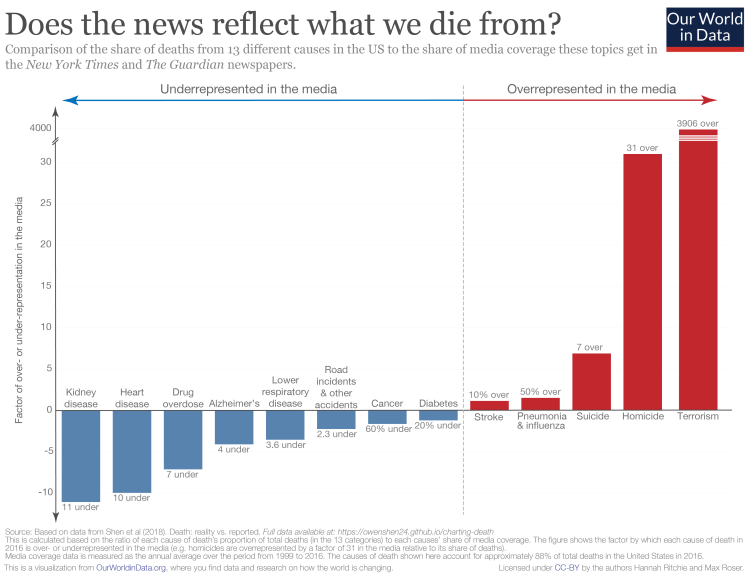
Does the news reflect what we die from?

This is a page from the excellent site, “Our World in Data” which describes its mission as:

We believe that a key reason why we fail to achieve the progress we are capable of is that we do not make enough use of this existing research and data: the important knowledge is often stored in inaccessible databases, locked away behind paywalls and buried under jargon in academic papers.

The goal of our work is to make the knowledge on the big problems accessible and understandable. As we say on our homepage, Our World in Data is about Research and data to make progress against the world’s largest problems.

This helps us evaluate how we acquire knowledge about the world and how reliable it is. Specifically, this helps us explore the contrast between emotion and reason as ways of acquiring knowledge and gives us some specific materials around the utility of math and data in learning about the world.

Among many questions they ask is whether the news reflects what we die from and why it matters. Great data and visuals along with discussions of the key issues involved.

https://ourworldindata.org/does-the-news-reflect-what-we-die-from
Over-and-underrepresentation-of-deaths-in-media

The short history of global living conditions and why it matters that we know it

From the same site an exploration of macro world trends regarding global living conditions and our misperceptions of them.

https://ourworldindata.org/a-history-of-global-living-conditions-in-5-charts

Two-centuries-World-as-100-people

Here is a simple handout I made from the relevant text from the above links along with appropriate graphs and images. I’ve added nothing  to these. Just cut and pasted what I thought was most relevant for a class. Haven’t used it yet.

Download Perception vs Truth

Related handouts:

Download Assessing Risk Handout

Here is the article that accompanies the handout above.

Download Ten Ways We Get the Odds Wrong

Some different questions that get at the same point.

Download Alternative Assessing Risk

Here is yet another interesting example from Swedish physician Hans Rosling. He came up with a simple quiz assessing people’s knowledge of human development statistics. Even development experts were woefully unaware. You can take the quiz here:

https://factfulnessquiz.com/