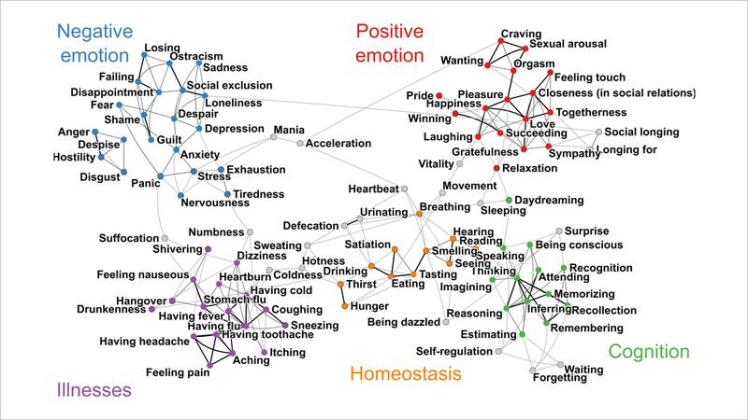
Feelings are a funny thing. Love and heartache both happen inside your head, but they’re felt in very different places. On the flipside, excitement and fear are two very different emotions, but they feel nearly identical. To make things even more complicated, feelings are subjective — it’s hard to know if other people feel things the same way you do. That’s why this new study from a team of Finnish researchers is so fascinating: They’ve mapped emotions to where most people feel them in their own bodies. It turns out that most of us feel our emotions in similar places.
Literary elites love to rep Shakespeare’s vocabulary: across his entire corpus, he uses 28,829 words, suggesting he knew over 100,000 words and arguably had the largest vocabulary, ever.
I decided to compare this data point against the most famous artists in hip hop. I used each artist’s first 35,000 lyrics. That way, prolific artists, such as Jay-Z, could be compared to newer artists, such as Drake.
The conventional view of history is filled with lone geniuses: men and women who, through talent and inspiration, achieved feats no one else had before. Pablo Picasso. Vincent van Gogh. Albert Einstein. Emily Dickinson.
Joshua Wolf Shenk…argues that the real driver of human creativity isn’t the lone genius, but the partnership.
“It’s something else — it’s feeling, emotion, preference, loyalty, convenience of the moment,” Mr. Hayden said. He quoted a former speechwriter for Mr. Bush, Michael Gerson, about Mr. Trump: “He lives in the eternal now — no history, no consequences.”
So don’t try to prove things; try to convince yourself. And be your own harshest critic and your own greatest skeptic. Every scientific theory will someday fail, and when it does, that will herald a new era of scientific inquiry and discovery. And of all the scientific theories we’ve ever come up with, the best ones succeed for the longest amounts of time and over the greatest ranges possible. In some sense, it’s better than a proof: it’s the most correct description of the physical world humanity has ever imagined.
We need to celebrate this collaboration more than ever, because it doesn’t happen on its own. It needs an environment that encourages researchers to build international and interdisciplinary teams, to work in different countries, to attack problems that no one person, or nation, can solve alone.
Psychologists have offered one explanation: that valuing our identity more than our accuracy is what leads us to accept incorrect information that aligns with our chosen political party’s beliefs.
How do we determine what is true? What role do emotions play in our acquisition of knowledge?
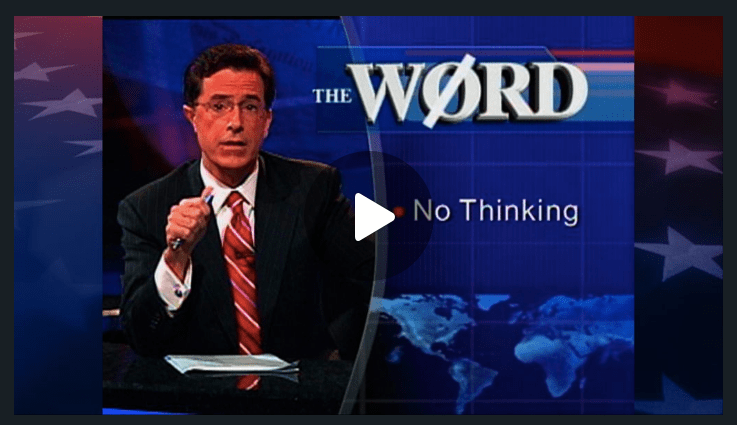
In this clip from 2005, Stephen Colbert coins his phrase, “truthiness” which to some degree portended the coming of “fake news” and its pervasiveness a decade later.
Facts are believable and “true if they “feel” true. This also lends itself to a discussion of the role of emotion in the acquisition of knowledge.
Knowledge Questions: How do we define art? Is art/creativity the exclusive domain of humans?
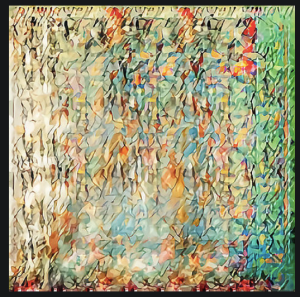
AI can produce pictures, but can it create art for itself?
Creativity is something we closely associate with what it means to be human. But with digital technology now enabling machines to recognize, learn from and respond to humans and the world — from digital assistant
s to driverless cars — an inevitable question follows: Can machines be creative? And will artificial intelligence ever be able to make art?
A philosopher argues that an AI can’t be an artist
Human creative achievement, because of the way it is socially embedded, will not succumb to advances in artificial intelligence. To say otherwise is to misunderstand both what human beings are and what our creativity amounts to.
This claim is not absolute: it depends on the norms that we allow to govern our culture and our expectations of technology. Human beings have, in the past, attributed great power and genius even to lifeless totems. It is entirely possible that we will come to treat artificially intelligent machines as so vastly superior to us that we will naturally attribute creativity to them. Should that happen, it will not be because machines have outstripped us. It will be because we will have denigrated ourselves.
Warner Music Group Signs an Algorithm to a Record Deal
One of the newest additions to the group of artists working with Warner Music Group — taking a spot alongside names like Ed Sheeran, Madonna, Coldplay and Camilla Cabello — is a bundle of code. It’s under contract to release 20 albums this year.
The creator of the algorithm is sound startup Endel, which uses artificial intelligence to make personalized audio tracks aimed at boosting people’s mood or productivity.
From Hastings to Dunkirk a past that blinds Britain to reality has been peddled.
Superiority, antagonism and a fear of betrayal are not healthy historical lessons; instead they encourage Britain’s worst tendencies. “All the wrong people are cheering,” Dora Gaitskell told her husband Hugh – then Labour leader – of his 1961 declaration that joining the EEC would be “the end of a thousand years of history”. As our experience in Ireland shows, Europe offered not an end but a new beginning. By refusing to confront its complex and difficult history, Britain is turning its back on decades of shared progress, to the dismay of its friends. Britannia is adrift on the waves, and only by facing its past can it reclaim its future.


 TOK Topics