Cartoon: How to Make Up Planets and Accidentally Influence People
In 2014, a grad student made a joke video about a celestial body coming to destroy Earth, and got way more than he bargained for.
(click on image for full cartoon)
In 2014, a grad student made a joke video about a celestial body coming to destroy Earth, and got way more than he bargained for.
(click on image for full cartoon)
13 minute talk that covers some interesting ground. What is truth? How do we arrived at it? Can there be multiple “truths”?
A couple of interesting quotes from his reflections on telling stories:
“…maybe I was relying too much on science to find the truth.”
“There were a lot of truths in the room at that moment and we were only looking at one of them.
He started to do stories where “everything is disputed all you can do is struggle to make sense. And the struggle kind of became the point.”
“We live in a world where truth is no longer just a set of facts to be captured. It’s a process. It’s gone from being a noun to being a verb.”
“I committed myself to doing stories where you heard truths collide.”
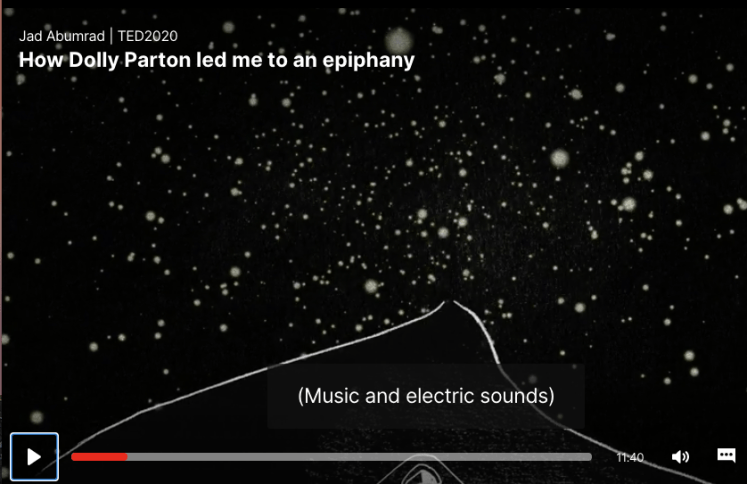
How do you end a story? Host of “Radiolab” Jad Abumrad tells how his search for an answer led him home to the mountains of Tennessee, where he met an unexpected teacher: Dolly Parton.
The metaphors of neuroscience – computers, coding, wiring diagrams and so on – are inevitably partial. That is the nature of metaphors, which have been intensely studied by philosophers of science and by scientists, as they seem to be so central to the way scientists think. But metaphors are also rich and allow insight and discovery. There will come a point when the understanding they allow will be outweighed by the limits they impose, but in the case of computational and representational metaphors of the brain, there is no agreement that such a moment has arrived. From a historical point of view, the very fact that this debate is taking place suggests that we may indeed be approaching the end of the computational metaphor. What is not clear, however, is what would replace it.
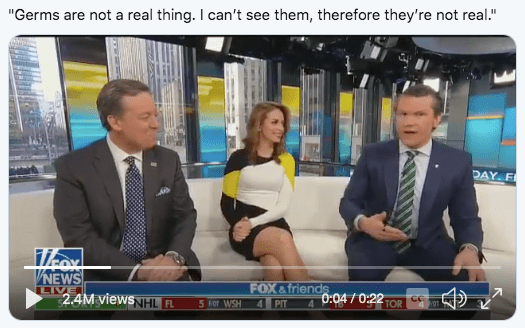
How a drug became an object lesson in political tribalism.
Why are we seeing the polarization over hydroxycholorquine, then, in spite of the serious consequences? The explanation may lie in the kind of information available to the public about COVID-19, which differs importantly from what we see in other cases of polarization about science. When it comes to the health effects of injecting disinfectants, there is no uncertainty about the massive risks. And for that reason, we don’t expect polarization to emerge, even if Trump suggests trying it. But even the best information about COVID-19 is in a state of constant flux. Scientists are publishing new articles every day, while old articles and claims are retracted or refuted. Norms of scientific publication, which usually dictate slower timeframes and more thorough peer review, have been relaxed by scientific communities desperately seeking solutions. And with readers clamoring for the latest virus news, journalists are on the hunt for new articles they can report on, sometimes pushing claims into prime time before they’ve been properly vetted.
After the publication of this article, there was a retraction of a high profile study that suggested hydrochloroquine would lead to increased mortality and was ineffective as a treatment for covid-19.
All of this happened in the hyperpolarized context of American politics, referred to in the article above, in which even scientific truth bent around President Trump’s words.
Historians believe that the past is irreducibly complex and the future wildly unpredictable. Scientists disagree. Who’s right?
‘Historical facts’ are not discrete items, awaiting scholars to hunt them down. They need to be created…
The danger here, of course, is that these approaches tend to assume that the natural sciences are capable of producing objective knowledge, and that mirroring their methodologies will produce ‘better’ knowledge for the rest of the academy. Half a century of research in the history of science has shown that this perspective is deeply flawed. The sciences have their own history – as indeed does the notion of objectivity – and that history is deeply entwined with power, politics and, importantly, the naturalisation of social inequality by reference to biological inferiority. No programme for understanding human behaviour through the mathematical modelling of evolutionary theory can afford to ignore this point.
https://aeon.co/essays/if-history-was-more-like-science-would-it-predict-the-future
Really well done short video, 13 minutes, about the quest to experimentally prove Einstein’s prediction about gravitational waves.
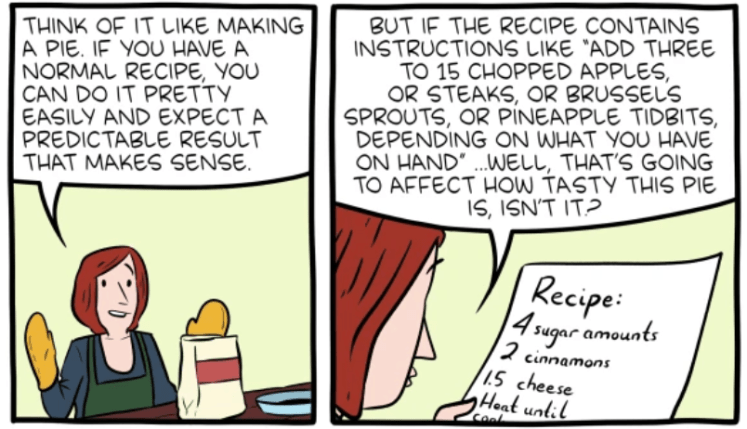
Artist Zach Weinersmith teams up with FiveThirtyEight to break down and explain the challenges in building accurate models for the pandemic from differing assumptions, data collection, and just a general lack of information.
Interesting quote from the cartoon: “Every variable is dependent on a number of possible choices and gaps in knowledge.”
Click on the images for the full cartoon.
https://fivethirtyeight.com/features/a-comic-strip-tour-of-the-wild-world-of-pandemic-modeling/
Reminds me of a funny tweet I saw, “Using the right denominator is 50% of data science.”
Great article for discussing the production of scientific knowledge, shared knowledge, and also the new knowledge and technology theme.
Scientific Cooperation Knows No Boundaries—Fortunately
Infectious diseases, it is commonly said, know no borders, and neither does the knowledge needed to fight them. Scientists around the world routinely share information and collaborate across borders. The current pandemic has scientists working together on platforms such as Slack, and using new tools, such as machine learning, to rapidly detect the novel coronavirus in tests that use large amounts data from multiple sources. This outbreak has demonstrated in real time how scientific understanding can indeed be a global public good.
https://www.foreignaffairs.com/articles/2020-03-21/it-takes-world-end-pandemic
So, it could be that the effect is all in your head. It could be that the effect is real, whether it’s placebo pain relief or measurable weight loss. But either way, if your experience flies in the face of research results, you’re probably going to go with your experience. And Hitchcock says that could be a completely rational decision. If the cost of continuing (say, paying for a supplement) is small compared to the risk of discontinuing (and potentially giving up the perceived benefit), it makes sense to keep on keeping on.
Here are some other articles related to natural sciences and diet