Tell us something we don’t know: why science can’t show us much about art

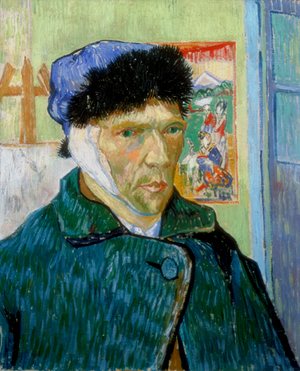
3762“The scientific ‘discovery’ that Van Gogh’s art changed after his 1888 breakdown proves a forensic approach is no match for the subjective eye of an art lover.

“There are objective results in science. There is no objective truth in art. It exists in our eyes and in our imaginations. I happen to agree with the research behind this latest Van Gogh investigation – that he got more strident and emotional in his art as his mental health declined – to the extent that I find the results obvious. But someone who has spent years looking at Van Gogh might disagree – she might see this as a melodramatic interpretation and argue that Van Gogh is not really an expressionist painter at all but a student of light and colour. That’s a valid point of view too, whatever the science says.

“Thanks to science, we know that we live on a rock orbiting a mediocre star in a mediocre galaxy. But we won’t ever invent a science that can tell us what Van Gogh’s painting Starry Night is about. The data lies hidden in our souls.”

The Man Who Studies Ignorance

“A new era of ignorance

““We live in a world of radical ignorance, and the marvel is that any kind of truth cuts through the noise,” says Proctor. Even though knowledge is ‘accessible’, it does not mean it is accessed, he warns.

““Although for most things this is trivial – like, for example, the boiling point of mercury – but for bigger questions of political and philosophical import, the knowledge people have often comes from faith or tradition, or propaganda, more than anywhere else.”

“Proctor found that ignorance spreads when firstly, many people do not understand a concept or fact and secondly, when special interest groups – like a commercial firm or a political group – then work hard to create confusion about an issue. In the case of ignorance about tobacco and climate change, a scientifically illiterate society will probably be more susceptible to the tactics used by those wishing to confuse and cloud the truth.”

http://www.bbc.com/future/story/20160105-the-man-who-studies-the-spread-of-ignorance?mc_cid=c28053bf7b&mc_eid=34e2887073

Is There such a Thing as Scientific Objectivity?

“This story has much to say about the nature of scientific knowledge. It is not, as we so often think, a collection of objective facts and unbiased observations that sprout in hermetically sealed environments, unsullied by human minds and hands. “On closer analysis,” writes science historian Paul Feyerabend, “we even find that science knows no ‘bare facts’ at all, but that all the ‘facts’ that enter our knowledge are already viewed in a certain way.” Facts come clothed in history, colored by context. Science is less a statement of truth than a running argument. As it turns out, the scientific method isn’t so “scientific” after all.”

https://tok2012.wikispaces.com/Scientific+Objectivity

The incredible tale of irresponsible chocolate milk research at the University of Maryland

“Academic press offices are known to overhype their own research. But the University of Maryland recently took this to appalling new heights — trumpeting an incredibly shoddy study on chocolate milk and concussions that happened to benefit a corporate partner.

“It’s a cautionary tale of just how badly science can go awry as universities increasingly partner with corporations to conduct research.”

http://www.vox.com/2016/1/16/10777050/university-of-maryland-chocolate-milk?mc_cid=84d899c964&mc_eid=34e2887073


Gravitational Waves Detected, Confirming Einstein’s Theory

This is an interesting article which highlights the relationship between theoretical and experimental physics. Theories are proposed that make certain predictions, as Einstein’s Theory of Relativity did, but the available experimental know how and technology of his day made some of his predictions impossible to confirm or deny. As time has gone on, certain predictions Einstein made have come to have experimental, observable evidence to support them. One of those predictions about the existence of gravitation waves, made over a hundred years ago, now has some evidence to support the prediction.

“More generally, it means that a century of innovation, testing, questioning and plain hard work after Einstein imagined it on paper, scientists have finally tapped into the deepest register of physical reality, where the weirdest and wildest implications of Einstein’s universe become manifest.”

More on this recent discovery along with a discussion of the value of such scientific discovery.

“Too often people ask, what’s the use of science like this, if it doesn’t produce faster cars or better toasters. But people rarely ask the same question about a Picasso painting or a Mozart symphony. Such pinnacles of human creativity change our perspective of our place in the universe. Science, like art, music and literature, has the capacity to amaze and excite, dazzle and bewilder. I would argue that it is that aspect of science — its cultural contribution, its humanity — that is perhaps its most important feature.”

Other predictions Einstein made that were later proven correct.

http://discovermagazine.com/2015/april/12-putting-relativity-to-the-test

And a great video from the Tonight Show explaining what all this is about.

Ethicists approve ‘3 parent’ embryos to stop diseases, but congressional ban remains

“But panel members said that they took the philosophical issues seriously, noting that someone with genetic material from two different maternal bloodlines would potentially have to wrestle with questions about identity, kinship and ancestry.

“They also countenanced the possibility that people would want to use this new technique to create babies that are enhanced in some way intellectually or physically. They said that is not a major concern at the moment because the feasibility of such enhancements remains speculative.”

https://www.washingtonpost.com/news/speaking-of-science/wp/2016/02/03/to-prevent-disease-ethicists-approve-creation-of-embryos-with-three-genetic-parents/?wpisrc=nl_draw2

Another article about the application of the technique.

Designing babies or saving lives in Mexico?

http://www.bbc.com/news/world-latin-america-37505751?utm_source=Premium+TOK+newsletter+subscribers&utm_campaign=7cdac1f063-EMAIL_CAMPAIGN_2016_11_01&utm_medium=email&utm_term=0_f031581d64-7cdac1f063-98485421&mc_cid=7cdac1f063&mc_eid=34e2887073

No food is healthy. Not even kale.

““ ‘Healthy’ is a bankrupt word,” Roxanne Sukol, preventive medicine specialist at the Cleveland Clinic, medical director of its Wellness Enterprise and a nutrition autodidact (“They didn’t teach us anything about nutrition in medical school”), told me as we strolled the aisles of a grocery store. “Our food isn’t healthy. We are healthy. Our food is nutritious. I’m all about the words. Words are the key to giving people the tools they need to figure out what to eat. Everyone’s so confused.”

“Last March, the Food and Drug Administration sent the nut-bar maker Kind a letter saying their use of the word “healthy” on their packaging was a violation (too much fat in the almonds). Kind responded with a citizens’ petition asking the FDA to reevaluate its definition of the word.

“If I may rephrase the doctor’s words: Our food is not healthy; we will be healthy if we eat nutritious food. Words matter. And those that we apply to food matter more than ever.”

https://www.washingtonpost.com/lifestyle/food/no-food-is-healthy-not-even-kale/2016/01/15/4a5c2d24-ba52-11e5-829c-26ffb874a18d_story.html

You Can’t Trust What You Read About Nutrition

“We found a link between cabbage and innie bellybuttons, but that doesn’t mean it’s real.”

“Our foray into nutrition science demonstrated that studies examining how foods influence health are inherently fraught. To show you why, we’re going to take you behind the scenes to see how these studies are done. The first thing you need to know is that nutrition researchers are studying an incredibly difficult problem, because, short of locking people in a room and carefully measuring out all their meals, it’s hard to know exactly what people eat. So nearly all nutrition studies rely on measures of food consumption that require people to remember and report what they ate. The most common of these are food diaries, recall surveys and the food frequency questionnaire, or FFQ.”

http://fivethirtyeight.com/features/you-cant-trust-what-you-read-about-nutrition/