Freakonomics Podcast: America’s Math Curriculum Doesn’t Add Up

KQs: What knowledge is worth knowing? What makes knowledge valuable?

I have four teenagers. I’ve spent a lot of time working with them on their math homework. More often than not, after helping them answer whatever questions are assigned that day, I’m left with questions of my own — questions that I can’t find good answers to. Why are we teaching kids these things? Does anyone actually use the math we are teaching in their daily life? Is there any benefit at all to learning this stuff? And are there not more interesting and useful things we could be teaching them? Don’t get me wrong. I’m not anti-math. I use mathematical thinking, statistics, and data analysis constantly, whether I’m writing economics papers, trying to get better at golf, or hoping to pick winners at the race track. But here is the thing: the math tools I actually use, and the math tools I see people around me actually using, seem to have nothing to do with what my kids are learning in school. Which makes me think that we must be able to better for our children when it comes to teaching them math.
https://freakonomics.com/podcast/math-curriculum/

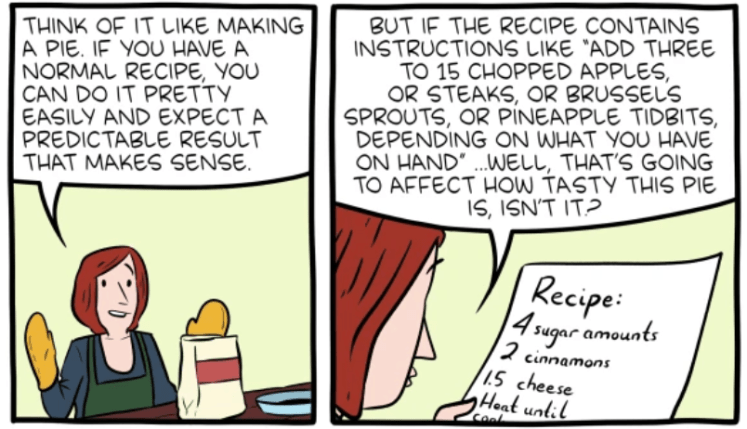
A Comic Strip Tour Of The Wild World Of Pandemic Modeling

Artist Zach Weinersmith teams up with FiveThirtyEight to break down and explain the challenges in building accurate models for the pandemic from differing assumptions, data collection, and just a general lack of information.

Interesting quote from the cartoon: “Every variable is dependent on a number of possible choices and gaps in knowledge.”

Click on the images for the full cartoon.

https://fivethirtyeight.com/features/a-comic-strip-tour-of-the-wild-world-of-pandemic-modeling/


Reminds me of a funny tweet I saw, “Using the right denominator is 50% of data science.”


Covid-19, the Evil Genius, and How to Think about Societal Risks

Interesting article connecting ideas about how we assess risk, the language we use, and how we interpret data depending on how it is presented to us. This connects well to the conflict between emotion and reason in decision making but also our inability to think probabilistically.

If you ask someone if they would be willing to sacrifice 100K people to avoid this intervention, people will be inclined to say no, “I would never put a price tag on human life, much less 100K human lives.” But let’s say you ask the question differently: “Would you be willing to accept a one in three thousand chance of dying this year to avoid this public health intervention?”… Once you ask the question this way then instead of focusing on the raw number of deaths, we can focus on the tradeoffs,

https://reason.com/2020/03/26/covid-19-the-evil-genius-and-how-to-think-about-societal-risks/#comments

.

Here are some additional materials related to how we think about numbers and risk, etc. from my Maths page

Here is the article that accompanies the handout above.

Some different questions that get at the same point.

Coronavirus ‘Hits All the Hot Buttons’ for How We Misjudge Risk

When you encounter a potential risk, your brain does a quick search for past experiences with it. If it can easily pull up multiple alarming memories, then your brain concludes the danger is high. But it often fails to assess whether those memories are truly representative.

A classic example is airplane crashes.

If two happen in quick succession, flying suddenly feels scarier — even if your conscious mind knows that those crashes are a statistical aberration with little bearing on the safety of your next flight.

All numbers are made up, some are useful: Keeping track of stuff is hard

All the data that we trust and believe on a daily basis, is only accurate in a specific context, at a specific time, and at a specific level. If you dig deep enough, ultimately all of the data in the world that drives major and minor decisions alike is built on wobbly foundations.

https://vicki.substack.com/p/all-numbers-are-made-up-some-are

Why you might be counting in the wrong language

Learning numbers in a European language has probably affected your early maths ability. It turns out there are better ways to count.

So even though we might all be using the same numbers, the words we use may influence how we think about them. They say maths is a universal language, but perhaps that’s not true after all.

https://www.bbc.com/future/article/20191121-why-you-might-be-counting-in-the-wrong-language

Art and reality: How accurately does “Euphoria” portray real teens’ lives? Does it matter?

The central point here is that the show Euphoria inaccurately portrays teenagers’ lives which raises the question: Is there a responsibility that comes with creating artwork? Must it be accurate? Who decides?

The claim that the show is inaccurate is backup with statistics raises the question: How can math/statistics help us acquire knowledge? (or understand reality?)

People’s perceptions of teens’ behaviors seems to be generally inaccurate beyond what this show. If presented with this article and appropriate statistics would people change their mind or perceptions of these issues? I’m not sure that it would which leads us to the question: What is the role of intuition in acquiring knowledge? Can mathematical knowledge overcome intuitive beliefs?

This reminded me of an earlier article from the New York Times:

“The Kids Are More Than All Right”

https://well.blogs.nytimes.com/2012/02/02/the-kids-are-more-than-all-right/

Where Proof, Evidence and Imagination Intersect

Screen Shot 2019-03-23 at 8.17.54 PM

In mathematics, where proofs are everything, evidence is important too. But evidence is only as good as the model, and modeling can be dangerous business. So how much evidence is enough?

Those mathematicians know to be cautious when working with their models. Because they know that no matter how useful and interesting their model, no matter how compelling the evidence they collect, there might be something out there about elliptic curves that they didn’t quite imagine. And if you can’t imagine it, your model can’t capture it, and that means the evidence won’t reflect it.

https://www.quantamagazine.org/where-proof-evidence-and-imagination-intersect-in-math-20190314/

A Songwriting Mystery Solved: Math Proves John Lennon Wrote ‘In My Life’

Mathematics professor Jason Brown spent 10 years working with statistics to solve the magical mystery. Brown’s the findings were presented on Aug. 1 at the Joint Statistical Meeting in a presentation called “Assessing Authorship of Beatles Songs from Musical Content: Bayesian Classification Modeling from Bags-Of-Words Representations.”

https://www.npr.org/2018/08/11/637468053/a-songwriting-mystery-solved-math-proves-john-lennon-wrote-in-my-life