‘Hey Bill Nye, Is Playing the Lottery Rational?’

“According to Bill Nye, the lottery acts as a tax on those who can least afford it. Most of the people who play the lottery statistically come from lower income and lower education backgrounds. This means that those who are measuring every dollar they earn may misguidedly waste crucial funds on the lottery, spending hundreds to thousands of dollars on a slim chance that they could win, even though it’s massively likely that they never will.”

http://bigthink.com/videos/bill-nye-on-the-chances-of-winning-the-lottery?mc_cid=6e8e6bd94e&mc_eid=34e2887073

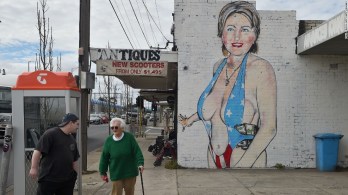
Melbourne graffiti artist sprays burqa over provocative Hillary Clinton mural

160803093028-australian-artist-clinton-mural-super-169Is censorship of artwork ever appropriate? If so, under what circumstances?

“A controversial mural of Hillary Clinton will be allowed to remain after the artist modified it from depicting the politician in a revealing swimsuit to one where she is wearing a burqa instead.”

http://edition.cnn.com/2016/08/02/asia/australia-clinton-mural-artist-burqa/

How juice companies game science to perpetuate the myth that cranberry prevents UTIs

“Conflict of interest in nutrition research is nothing new. Health food is a billion-dollar business, and the more virtuous the food, the better it sells.

“From walnut growers to grape juice producers, there are hundreds of examples of companies and industry groups funding so-called independent studies that corroborate marketing claims about their product’s ability to improve health and fight disease.”

http://www.vox.com/2016/6/17/11937908/cranberries-urinary-tract-infections%20?mc_cid=1e136768f2&mc_eid=34e2887073

272 Slaves Were Sold to Save Georgetown. What Does It Owe Their Descendants?

This article raises a lot of interesting questions and issues.

The use of documentary evidence to reconstruct past events, motivations and the movement of people raises the question: How do we learn about the past? When there is a gap in the historical record, it’s impossible for us to know certain things. Documents were also used to trace modern day descendants of these slaves who were sold.

This article also raises questions about whether we, presently, have any responsibility for the past actions of our institutions or governments. Can we make amends for the past? Can a moral “debt” be paid off monetarily? Through remembrance? Plaques?

Lastly, this raises the question of what history is worth knowing? When learning history we have to make choices about what to include and what to exclude in addition to the choices we make around interpretation.

You should also read some of the comments for this article because they communicate diverse opinions about these questions.

“In 1838, the Jesuit priests who ran the country’s top Catholic university needed money to keep it alive. Now comes the task of making amends.”

“Meanwhile, Georgetown’s working group has been weighing whether the university should apologize for profiting from slave labor, create a memorial to those enslaved and provide scholarships for their descendants, among other possibilities, said Dr. Rothman, the historian.

“‘It’s hard to know what could possibly reconcile a history like this,’ he said. ‘What can you do to make amends?'”

http://www.nytimes.com/2016/04/17/us/georgetown-university-search-for-slave-descendants.html?_r=0

The Planet Money Podcast recently did two episodes on this question. You can find the links here:

http://www.npr.org/sections/money/2017/04/21/525058118/episode-766-georgetown-louisiana-part-one

http://www.npr.org/sections/money/2017/04/26/525769269/episode-767-georgetown-louisiana-part-two
 

Building a Better Human With Science? The Public Says, No Thanks

We will increasingly have to deal with questions and issues raised by our increasingly sophisticated abilities to alter genes and enhance humans through the use of biotechnologies. As our scientific abilities increase so too do the questions around the ethical use of such technologies. This article discusses public opinions around the abstract uses of these technologies.

What should the limits of the uses of these technologies be? What criteria should we use to determine these limits?

“Americans aren’t very enthusiastic about using science to enhance the human species. Instead, many find it rather creepy.

“A new survey by the Pew Research Center shows a profound distrust of scientists, a suspicion about claims of progress and a real discomfort with the idea of meddling with human abilities. The survey also opens a window into the public’s views on what it means to be a human being and what values are important.”

http://www.nytimes.com/2016/07/27/upshot/building-a-better-human-with-science-the-public-says-no-thanks.html

Are GMOs safe? Yes. The case against them is full of fraud, lies, and errors.

“GMO labels won’t clear this up. They won’t tell you whether there’s Bt in your food. They’ll only give you the illusion that you’ve escaped it. That’s one lesson of the Non-GMO Project, whose voluntary labels purport to give you an “informed choice” about what’s in your food.”

“That’s the fundamental flaw in the anti-GMO movement. It only pretends to inform you. When you push past its dogmas and examine the evidence, you realize that the movement’s fixation on genetic engineering has been an enormous mistake. The principles it claims to stand for—environmental protection, public health, community agriculture—are better served by considering the facts of each case than by treating GMOs, categorically, as a proxy for all that’s wrong with the world. That’s the truth, in all its messy complexity. Too bad it won’t fit on a label.”

http://www.slate.com/articles/health_and_science/science/2015/07/are_gmos_safe_yes_the_case_against_them_is_full_of_fraud_lies_and_errors.html?wpsrc=sh_all_tab_tw_top

The Quest to Resurrect Extinct Species

“A father-son duo of biologists has set the stage for so-called de-extinction. But should we be doing this at all?”

“In the past, scientists played their cards close to the vest as they developed, then commercialized, powerful new technologies. Often, they were sure that what was best for the science was best for society. And time after time, their secrecy and paternalism fed fears that sparked a public backlash — over technologies as diverse as test-tube babies, cloned animals like Dolly the sheep and genetically modified organisms. “The reason we’re in this situation with [the backlash against] genetically modified organisms is because we didn’t talk about it clearly enough, early enough,” Church says.”

http://discovermagazine.com/2015/march/14-jurassic-arke

Sorry, There’s Nothing Magical About Breakfast

Good reviews of all the observational research note the methodological flaws in this domain, as well as the problems of combining the results of publication-bias-influenced studies into a meta-analysis. The associations should be viewed with skepticism and confirmed with prospective trials.

“Few randomized controlled trials exist. Those that do, although methodologically weak like most nutrition studies, don’t support the necessity of breakfast.”

This article raises some interesting points about what is “good science” and also raises the issue of how hard it is to “know” things when it comes to nutrition. Though not the main focus, the article also touches upon whether the funding source of a study affects the conclusion and how ethical it is to fund a self serving study.

http://www.nytimes.com/2016/05/24/upshot/sorry-theres-nothing-magical-about-breakfast.html?_r=0