The Man Who Studies Ignorance

“A new era of ignorance

““We live in a world of radical ignorance, and the marvel is that any kind of truth cuts through the noise,” says Proctor. Even though knowledge is ‘accessible’, it does not mean it is accessed, he warns.

““Although for most things this is trivial – like, for example, the boiling point of mercury – but for bigger questions of political and philosophical import, the knowledge people have often comes from faith or tradition, or propaganda, more than anywhere else.”

“Proctor found that ignorance spreads when firstly, many people do not understand a concept or fact and secondly, when special interest groups – like a commercial firm or a political group – then work hard to create confusion about an issue. In the case of ignorance about tobacco and climate change, a scientifically illiterate society will probably be more susceptible to the tactics used by those wishing to confuse and cloud the truth.”
http://www.bbc.com/future/story/20160105-the-man-who-studies-the-spread-of-ignorance?mc_cid=c28053bf7b&mc_eid=34e2887073

TOK Presentation Info

1. Presentation stuff from the TOK guide
Presentation Basics

2. Presentation Form
OCC_d_0_tokxx_form_1505_6_e

3. Presentation tips
https://prezi.com/7nugodcso5zd/tok-presentation-tips/

4. TOK Presentation stuff on youtube:TOK Presentation Model
https://www.youtube.com/watch?v=-K3RPhENBYY

Other Videos
https://www.youtube.com/results?search_query=TOK+presentations

5. Sample TOK Presentation formThis is the form for the presentation we saw in class.
presentation 1 TKPPD_en

This is the map of their presentation
presentation 1 ppt_en

Here are the examiner’s comments
Presentation Examiner Notes

Schedule and topics

Planning Days (6)3/7, 3/9, 3/11, 3/15, 3/17, 3/21

Presentation Schedule (5 Days)

Wednesday 3/23

  • Rakia and Peyton: Racism (Police killing): Are human beings inherently prejudiced?
  • Anish and Sudipta: Child Labor: Ethical to employ children?
  • Marika and Khadija: Euthanasia: Is it ever ethical to kill a person?

Monday 3/28

  • Christian: The Ethics of Watching Football: How should the well being of others influence our ethical decisions?
  • Chaitanya: Little Albert Experiments: How is knowledge constructed in the human sciences?
  • Silvia and Briana: China’s One Child Policy: Should governments be allowed to disregard individual rights in favor of the common good?
  • Syeda and Inarra NSA Data Mining: Is it ethical?


Wednesday 3/30

  • Stephanie, Erica, and Faiza: Restrictions/Limitations of teaching history: How do present circumstances affect out interpretation of the past?
  • Vivian and Carolyn: What is the role of social experiments in the human sciences in the construction of knowledge?

Friday 4/1

  • Justin and Luca: Waterboarding Bush Administration: Is torture ever ethical?
  • Matteo and Sumin Stop and Frisk Ethics:
  • Sumaiya and Mahaut: 2012 Aurora Shooting: What roles do emotion and reason play in determining what is ethical?

Tuesday 4/5

  • Tenzin and Debraj: Ethics of illegal music downloading: Is it ever ethical to use or take intellectual property without permission?
  • Luis: Genetically engineered children: What are the ethical limitations of genetic engineering?

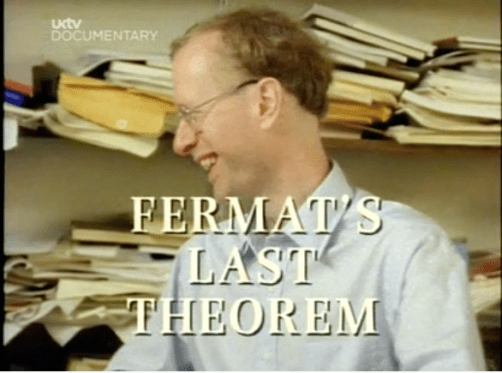
Video: Fermat’s Last Theorem

“In June 1993 he reached his goal. At a three-day lecture at Cambridge, he outlined a proof of Taniyama – and with it Fermat’s Last Theorem. Wiles’ retiring life-style was shattered. Mathematics hit the front pages of the world’s press. Then disaster struck. His colleague, Dr Nick Katz, made a tiny request for clarification. It turned into a gaping hole in the proof. As Andrew struggled to repair the damage, pressure mounted for him to release the manuscript – to give up his dream. So Andrew Wiles retired back to his attic. He shut out everything, but Fermat.”

(Click on the image to view documentary)

Is There such a Thing as Scientific Objectivity?

“This story has much to say about the nature of scientific knowledge. It is not, as we so often think, a collection of objective facts and unbiased observations that sprout in hermetically sealed environments, unsullied by human minds and hands. “On closer analysis,” writes science historian Paul Feyerabend, “we even find that science knows no ‘bare facts’ at all, but that all the ‘facts’ that enter our knowledge are already viewed in a certain way.” Facts come clothed in history, colored by context. Science is less a statement of truth than a running argument. As it turns out, the scientific method isn’t so “scientific” after all.”

https://tok2012.wikispaces.com/Scientific+Objectivity

Odd Emotions By coming to grips with unnamed feelings—from the need to connect deeply with someone we’ve just met to the desire to know how things will turn out—we can master our interior life.

Labeling emotions isn’t necessary for their primary—and immediate—purpose. “The conscious understanding of emotions is superfluous from a survival standpoint,” Gillihan says. “If I’m running away from a tiger in caveman days, I never say to myself, ‘I am afraid.’ I just think, Tiger! I’ve got to get out of here! I handle the threat and survive.” In modern times, however, our feelings often arise from our relationships, careers, and travel, and we benefit from a more considered response, he says. “It helps to be able to put a frame around more complex emotions.”

https://www.psychologytoday.com/articles/201601/odd-emotions?collection=1084379&mc_cid=84d899c964&mc_eid=34e2887073

The incredible tale of irresponsible chocolate milk research at the University of Maryland

“Academic press offices are known to overhype their own research. But the University of Maryland recently took this to appalling new heights — trumpeting an incredibly shoddy study on chocolate milk and concussions that happened to benefit a corporate partner.

“It’s a cautionary tale of just how badly science can go awry as universities increasingly partner with corporations to conduct research.”

http://www.vox.com/2016/1/16/10777050/university-of-maryland-chocolate-milk?mc_cid=84d899c964&mc_eid=34e2887073


Iceland Is Officially Worshiping Norse Gods Again

Hilmarsson said: “I don’t believe anyone believes in a one-eyed man who is riding about on a horse with eight feet. We see the stories as poetic metaphors and a manifestation of the forces of nature and human psychology.” Membership in Asatruarfelagid has tripled in Iceland to 2,400 members, out of a total population of 330,000.

http://bigthink.com/ideafeed/iceland-to-officially-worship-norse-gods-again?mc_cid=84d899c964&mc_eid=34e2887073

False memories: What would it mean if our most precious recollections had never happened?

“Some of your most cherished memories may not be as reliable as you think they are. So an artist who has spent the past three years collating 2,000 examples of false memories tells Kate Hilpern”