Read my lips: the rise and rise of photo-editing

For my generation, editing your own image has become as routine as using social media. We grew up with airbrushing and Photoshop and saw the exposés of flawless magazine cover stars who weren’t flawless at all. Instead of rejecting the falsehoods we’ve made it part of our daily lives, crafting idealised digital versions of ourselves that feel like an essential corollary to real life. Technology has set a new standard for beauty that quite literally doesn’t exist in real life. Rather than reject that, we’ve embraced it.

https://www.1843magazine.com/style/read-my-lips-the-rise-and-rise-of-photoediting

What makes a thing, a thing? What makes you, you? Broken axes and the Ship of Theseus.

The Ship of Theses is an ancient story that raises profound philosophical questions about the nature of identity. This TED Ed video does a nice job summarizing the story and the issues it raises.


A similar issue is raised in the movie, John Dies in the End.

Here is a lesson plan designed around the second clip.

“What is an axe” Lesson Plan


The Inquiry Podcast: Can We Teach Robots Ethics?

From driverless cars to “carebots”, machines are entering the realm of right and wrong. Should an autonomous vehicle prioritise the lives of its passengers over pedestrians? Should a robot caring for an elderly woman respect her right to life ahead of her right to make her own decisions? And who gets to decide? The challenges facing artificial intelligence are not just technical, but moral – and raise hard questions about what it means to be human.

https://www.bbc.co.uk/radio/play/w3csv1c2


Whole Foods: America’s Temple of Pseudoscience

From the probiotics aisle to the vaguely ridiculous Organic Integrity outreach effort (more on that later), Whole Foods has all the ingredients necessary to give Richard Dawkins nightmares. And if you want a sense of how weird, and how fraught, the relationship between science, politics, and commerce is in our modern world, then there’s really no better place to go. Because anti-science isn’t just a religious, conservative phenomenon—and the way in which it crosses cultural lines can tell us a lot about why places like the Creation Museum inspire so much rage, while places like Whole Foods don’t.

https://www.thedailybeast.com/whole-foods-americas-temple-of-pseudoscience?via=twitter_page

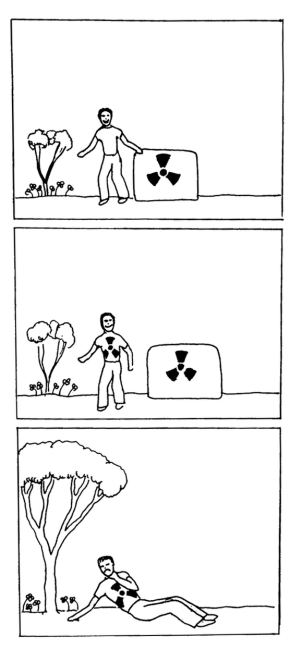
How do you communicate danger to people 10,000 years into the future?

lomberg-comic

In this 99 percent invisible podcast and accompanying article, the challenges of communicating the hazards of materials that will be radioactive for the next 10,000 years are discussed. This is an interesting exercise in thinking about how to communicate the the most “universal” way possible.


This WIPP site is going to be radioactive for hundreds of thousands of years, though this panel was only responsible for keeping this place sufficiently marked for humans for the next 10,000 years—thinking beyond that timeframe was thought to be impossible.

Though 10,000 years in the future is still fairly inconceivable. 10,000 years ago, the biggest new technology spreading across the planet was farming. Culturally, we share almost nothing with people alive back then. Who knows the world will look like 10,000 years from now?

The panel began by thinking about language. But language, like radioactive materials, has a half life. Beowulf, from only 1,000 years ago, is incomprehensible today.

The panel also considered symbols, which seemed like they might be more universal. A smiley face seems to have a global appeal. And face logos have already been used as warnings.

https://99percentinvisible.org/episode/ten-thousand-years/

Neil deGrasse Tyson on the “three kinds of truth”

In this 5 minute clip, from the Joe Rogan podcast, Neil deGrasse Tyson discusses his idea of the three different kinds of “truth.” It’s an interesting discussion on the definition of the word but also the implications of how we use words. Short enough to be interesting but not so long as to be tedious. For a tedious conversation on truth, see the previous post on the conversation between Sam Harris and Jordan Peterson.

I linked the video at the start of the relevant conversation.

Below is just the audioclip that you can stream just the audio if youtube is blocked and download below that if you just want the mp3 file.

Download Tyson 3 truths edit

SPEAKING OF “TRUTH” WITH JORDAN B. PETERSON

We spent two hours debating what it means to say that a proposition is (or seems to be) “true.” This is a not trivial problem in philosophy. But the place at which Peterson and I got stuck was a strange one. He seemed to be claiming that any belief system compatible with our survival must be true, and any that gets us killed must be false.

https://samharris.org/speaking-of-truth-with-jordan-b-peterson/

How History Classes Helped Create a ‘Post-Truth’ America The author of Lies My Teacher Told Me discusses how schools’ flawed approach to teaching the country’s past affects its civic health.

Textbooks should admit uncertainty. The very first thing that we teach in U.S.-history courses is when and how people first got to the Americas. The best answer is: We’re not sure. But the darned textbooks don’t say that—except for one of the 18 textbooks I studied intensively. Ironically, it’s the oldest one—it was published way back in the 1970s, and it says something like: The information in this section may be outdated by the time you read it. And by just saying that, it turns out to be the only textbook that is not outdated, even in 2018.

https://www.theatlantic.com/education/archive/2018/08/history-education-post-truth-america/566657/?