The Blind Men and the Elephant
September 30, 2018
TOK Teacher
When students come into Dan Levitin’s lab, he spends most of his time trying to teach them that they don’t know everything they think they do. “Knowledge can only be created in an environment where we’re open to the possibility that we’re wrong,” he says. Levitin shares his humble opinion on the best way to help students.
Human cleverness arises from distributing knowledge between minds, making people think they know more than they do
The hive mind, with its seamless interdependence and expertise-sharing, once helped humans hunt mammoths and now sends them into space. But in politics it causes problems. Using a toilet without understanding it is harmless, but changing the health-care system without understanding it is not. Yet people often have strong opinions about issues they understand little about. And on social media, surrounded by like-minded friends and followers, opinions are reinforced and become more extreme. It is hard to reason with someone under the illusion that their beliefs are thought through, and simply presenting facts is unlikely to change beliefs when those beliefs are rooted in the values and groupthink of a community.
https://www.economist.com/books-and-arts/2017/04/08/youre-not-as-smart-as-you-think-you-are
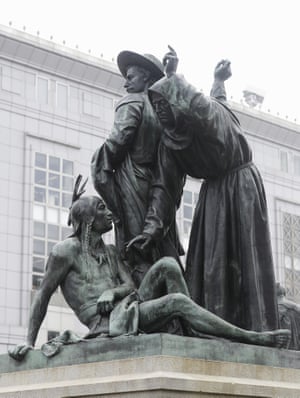
Art is in the eye of the community
So if the statue doesn’t provide an accurate idea of history, is it valid as a piece of public art? Jeff Hou, a professor of landscape architecture at the University of Washington, says no. He says the public realm is accountable to one audience – the public.
“In the public realm, works of arts and design are subject to the public process. In other words, the public can have a say in what’s appropriate in a public space in a democracy,” he told me.
“A lot of common terms may seem ‘neutral’ but reinforce racism. A teacher’s textbook case.”
Wilderness? Permanent? More loaded terms
“Wilderness” is another problematic term. It implies a place that humans neither modify nor call home. So when we attempt to convey respect for Indigenous knowledge with sentences like “Indigenous people were highly skilled at navigating and surviving in the “wilderness,” we present an oxymoron. Were Indigenous peoples other than human? If it is wilderness, how can people inhabit it? Allowing this paradox to stand sustains questions that should long ago have been taken off life support, but that retain vibrancy in powerful arenas, not the least of which include our courts: Were these “organized societies” living in the wilderness? Did these people have “exclusive use and occupation” of the wilderness? The absurdity of these questions comes clear when we jettison “wilderness” for more appropriate language, something like “homeland” or better yet, the people’s own term, the hahuułni of the Nuu-chah-nulth, Haa Aani among the Tlingit, or Anishinaabe akiiing. Kimmerer tells us, “When we call a place by its name it is transformed from wilderness to homeland.”
Our conversation about how all history is revisionist and open to creativity with Michael Douma continues this week.
You don’t have a weaker understanding by having an additional explanation, every additional explanation that you have makes the painting come more alive and stronger. That history described and explained from different perspectives is history better understood. And so, a historical pluralist like myself would say there is not one objective story to be told, there’s true stories and false stories based on correspondence theory. But we can look at any event and tell many different stories depending on what it is, that we wanna pull out there what do we wanna highlight what is important to us because history is always written from the perspective of the historian.
https://www.libertarianism.org/podcasts/liberty-chronicles/more-creative-historical-thinking
A series of articles on the fire at the national museum in Brazil. Raises questions about the role of material culture in studying the past but also of the concept of “national memory.” Further, there were recordings of languages that are no longer spoken that were destroyed. Does the loss of a language represent a loss of knowledge? A knowledge system? Fascinating questions raised by this incident that speak to the volume of loss.
The losses are “incalculable to Brazil,” said Michel Temer, the country’s president, on Twitter. “Two hundred years of work, research and knowledge have been lost.”
Marina Silva, a candidate in Brazil’s upcoming elections, described the fire as “a lobotomy in Brazilian memory.”
https://www.theatlantic.com/science/archive/2018/09/brazil-rio-de-janeiro-museum-fire/569299/
It didn’t have to be this way. All of these artifacts could have been systematically backed up over the years with photographs, scans, audio files. The failure to do so speaks to a vital truth about the limits of technology: Just because the means to do something exists technologically doesn’t mean it will be done. And it underscores that the academic community has not yet fully embraced the importance of archiving importance of archiving—not just in Brazil, but around the world.
https://www.wired.com/story/brazil-museum-fire-digital-archives/
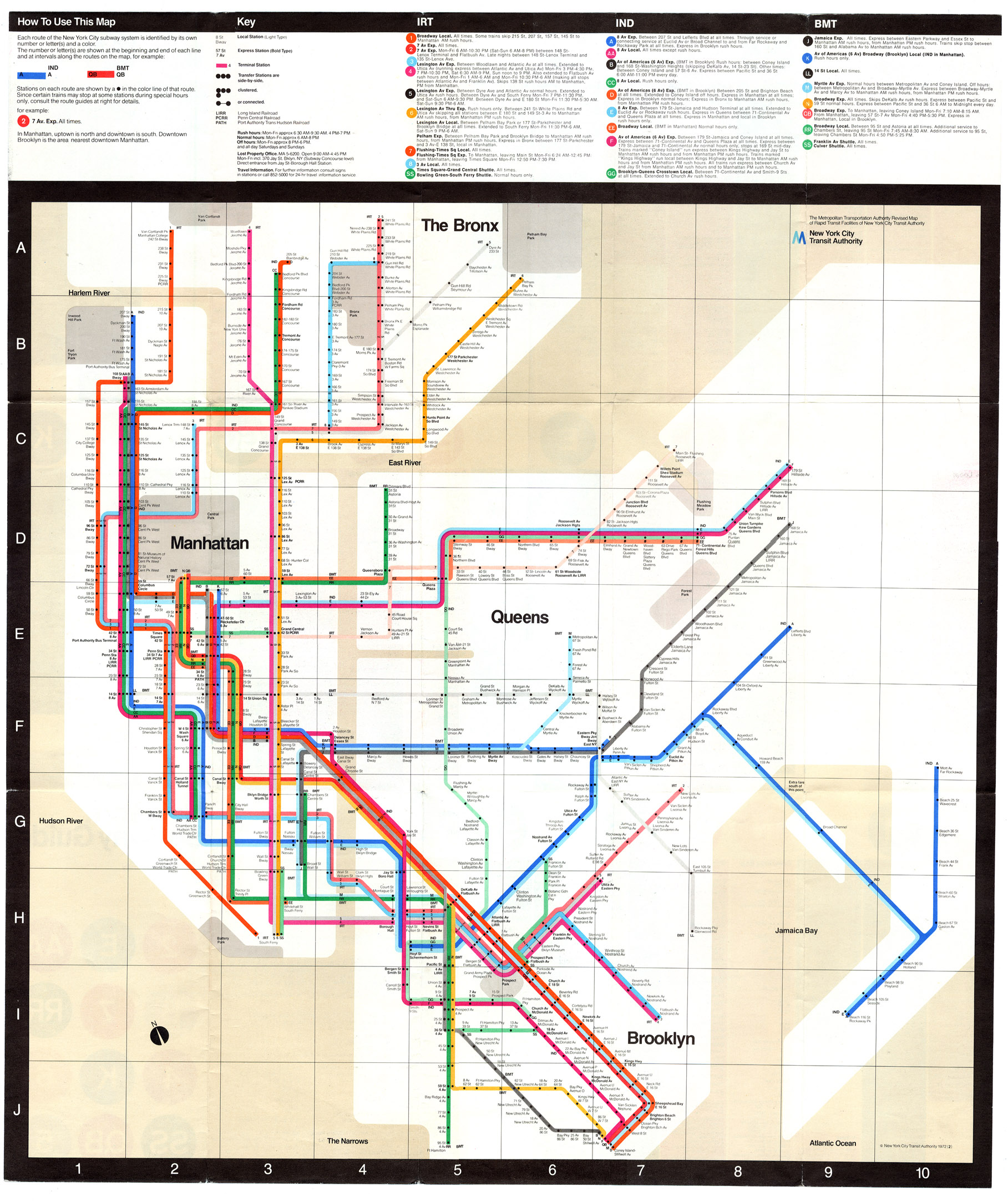
The quote, “The map is not the territory,” demonstrates a profound thought, and also a useful prompt for the TOK class. Before getting into connections between the quote and idea of models and metaphors, I wanted to put together a lesson on NYC subway maps (my school is in NYC). While doing so, I came across a bunch of different, and lovely, maps, each with its own representation of “reality.”
Download handout: NYC Map Handout
Click each image for a full size file.
1. Modern Day Subway Map
This is the map you see posted on the trains and subway platforms.

2. “Accurate Subway Map”
This map includes more accurate representations of distance and other features. Notice also it is more accurately oriented according to a traditional North-South map axis. The one above unintentionally (intentionally?) reorients the map around Manhattan.

3. NYC Station Map
This map focuses on the subway lines themselves and erases all other features.

4. 1972 Massimo Vignelli Map
Much has been written about this map and the response it got. It put into practice the design principles (started in the London Underground Map designed by Harry C. Beck) that are used in many of the world’s systems. This map, though, did not receive a particularly positive reaction and was soon abandoned.
This site will morph the subway map into the actual geographic map for various metros around the world including New York. Really cool.
If you’re interested in this topic, you can find a lot more maps and more information at: https://www.nycsubway.org/wiki/New_York_City_Subway_Track_Maps (Click on the “Maps” tab at the top of that page).
“What are the philosophical underpinnings of libertarianism?”
Interesting debate about consequentialism vs. deontology as far as justifying libertarianism as a political and economic philosophy.
“Don’t get me wrong—rights are important. But they’re important because they’re beneficial. Private property, free trade, and civil liberties are valuable as means to a prosperous, peaceful, and happy world.”
…
“The trouble is, deontologists have a hard time explaining why enriching the poor and healing the sick matter at all. At most, these are fringe benefits of liberty. To deontologists, a political system that feeds the hungry is like a polio vaccine that freshens your breath—the bonus is nice, but it’s not the point. This view gets things wrong, however. That freedom makes us happier, healthier, and wealthier is the point.”
…
“Morally good things can make people happier. But I have often noticed that morally bad things can make people happier too: A petty thief steals a tomato from a neighbor’s garden. The neighbor thinks an animal ate it. The thief loves to steal, and the neighbor is only mildly disappointed. Aggregate happiness has increased, yet we find the thief’s action despicable.”
https://reason.com/archives/2018/09/09/proposition-the-best-case-for
 TOK Topics