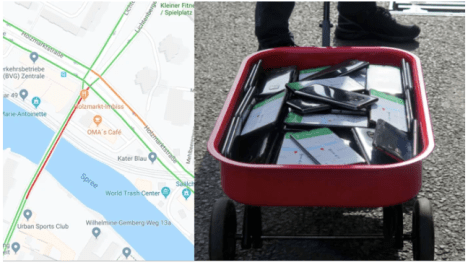
This Man Created Traffic Jams on Google Maps Using a Red Wagon Full of Phones

Screen Shot 2020-02-05 at 9.25.35 AM

The maps are their own territory, their own objective reality, not just a reflection of the real world but a branch of it. Weckert was showing us all how data and maps can affect the world they’re meant to chart. “Maps have the potential as an instrument of power,” he said. “They substitute political and military power in a way that represents the state borders between territories and they can repeat, legitimate, and construct the differences of classes and social self-understandings.”

https://www.vice.com/en_us/article/9393w7/this-man-created-traffic-jams-on-google-maps-using-a-red-wagon-full-of-phones

An algorithm that can spot cause and effect could supercharge medical AI

How do we make better use of this piecemeal information? Computers are great at spotting patterns—but that’s just correlation. In the last few years, computer scientists have invented a handful of algorithms that can identify causal relations within single data sets. But focusing on single data sets is like looking through keyholes. What’s needed is a way to take in the whole view. 

https://www.technologyreview.com/s/615141/an-algorithm-that-can-spot-cause-and-effect-could-supercharge-medical-ai/?utm_source=newsletters

Panicking About Your Kids’ Phones? New Research Says Don’t

A topic rich for TOK discuss. Seemingly all people have an opinion on the impact of smart phones on society so this topic pits intuition and personal experience against scientific investigation. This is one of the top comments that accompanies the article

I don’t care what the “academics” say. My experience as a teacher in the trenches tells a different story. One of the top reasons I retired early was cellphone addiction. All of the teachers on our campus was losing their minds because of them. My students turned into zombies. Between social media, video games, and porn, they showed zero interest in learning anything . Also, explain to me, after almost 30 years of teaching, I lost six senior girls in my last two years. Four of them my last year. All of the girls dropped out because of anxiety/depression. I have never seen anything like it in my career.

This raises article also raises questions about how we produce knowledge in the natural sciences, the role of an individual study, what high quality science is, the concept of a meta analysis, and questions about correlation vs. causation as well.

Ms. Twenge’s critics argue that her work found a correlation between the appearance of smartphones and a real rise in reports of mental health issues, but that it did not establish that phones were the cause.

It could, researchers argue, just as easily be that the rise in depression led teenagers to excessive phone use at a time when there were many other potential explanations for depression and anxiety. What’s more, anxiety and suicide rates appear not to have risen in large parts of Europe, where phones have also become more prevalent.

“Why else might American kids be anxious other than telephones?” Mr. Hancock said. “How about climate change? How about income inequality? How about more student debt? There are so many big giant structural issues that have a huge impact on us but are invisible and that we aren’t looking at.”

Here is a good short version of the same topic.

https://www.technologyreview.com/f/615071/your-kids-phone-probably-isnt-making-them-depressed/
Australia fires: Aboriginal planners say the bush ‘needs to burn’

Indigenous cultural burns work within the rhythms of the environment, attracting marsupials and mammals which Aboriginal people could hunt.

“Cool burning replenishes the earth and enhances biodiversity – the ash fertilises and the potassium encourages flowering. It’s a complex cycle based on cultural, spiritual and scientific knowledge.”

https://www.bbc.com/news/world-australia-51043828

American history textbooks can differ across the country, in ways that are shaded by partisan politics.

The latest in a never ending series of discussions about the nature of history textbooks and the politics that play into what students learn about. This article does a good job surveying differences more than making larger points about the nature of history but still worthwhile. Here are more links to more articles about controversies over history textbooks.

“At the end of the day, it’s a political process,” said Jesús F. de la Teja, an emeritus professor of history at Texas State University who has worked for the state of Texas and for publishers in reviewing standards and textbooks.

The differences between state editions can be traced back to several sources: state social studies standards; state laws; and feedback from panels of appointees that huddle, in Sacramento and Austin hotel conference rooms, to review drafts.

I Worked at Capital One for Five Years. This Is How We Justified Piling Debt on Poor Customers.

Interesting story that raises many interesting questions about ethics and responsibility. What is the responsibility of the institution vs. individual? How do we decide what is ethical? The article describes a level of abstraction and jargon that happens in the company that belies the very human cost of its actions. Further, how do our actions change when we don’t directly deal with the human face/cost of our actions?

People at Capital One are extremely friendly. But one striking fact of life there was how rarely anyone acknowledged the suffering of its customers. It’s no rhetorical exaggeration to say that the 3,000 white-collar workers at its headquarters are making good money off the backs of the poor. The conspiracy of silence that engulfed this bottom-line truth spoke volumes about how all of us at Capital One viewed our place in the world, and what we saw when we looked down from our glass tower.

Amid the daily office banter at Capital One, we hardly ever broached the essence of what we were doing. Instead, we discussed the “physics” of our work. Analysts would commonly say that “whiteboarding”—a gratifying exercise in gaming out equations on the whiteboard to figure out a better way to build a risk model or design an experiment—was the favorite part of their job. Hour-long conversations would oscillate between abstruse metaphors representing indebtedness and poverty, and an equally opaque jargon composed of math and finance-speak.

https://newrepublic.com/article/155212/worked-capital-one-five-years-justified-piling-debt-poor-customers

Emojis prove intent, a judge in Israel ruled

On the surface this ruling may seem silly. The smiley pictogram is internationally popular precisely because it’s simple for most people to understand, or so it seems superficially. One of the messages in question was supported with victory signs, champagne, a quilt of symbols that’s barely translatable but clearly positive. In fact, however, emoji in a legal context is very serious business.

Language interpretation is rarely simple upon close examination and lawyers can argue anything. Pictures give them a lot of room to do so.

Santa Clara University law professor Eric Goldman searched for 2016 cases in the US that dealt with emojis and emoticon and found about 80 judicial opinions that mentioned these.

He told The Recorder in May that he imagines that emoji interpretation issues will only get more common and could get very difficult. The images look different to each of us, and parties can have legitimately different understandings of an image used in an exchange.

https://qz.com/987032/emojis-prove-intent-a-judge-in-israel-ruled/

.

How Emojis Have Invaded the Courtroom

In 2019, dozens of emojis showed up in legal cases. Here’s a look at the different ways they’ve been used.

https://slate.com/technology/2019/11/emoji-court-cases-crime-free-speech-contract-law.html

How one city hopes language monitoring can help it defeat hate

Once Hatebase has the data, it is automatically sorted and annotated. These annotations can explain the multiple meanings of the terms used, for example, or their level of offensiveness. The resulting data can also be displayed in a dashboard to make it easier for city officials to visualize the problem.

Once enough data has been gathered (most likely in a few months’ time), the city will use Hatebase’s system to monitor trends in hate-speech usage across Chattanooga, and see if there are any patterns between the words used against particular groups and subsequent hate crimes. Often, violence against a particular group is preceded by an increase in dehumanizing, abusive language used against that group. The Sentinel Project has already used this sort of language monitoring successfully as an early warning system for armed ethnic conflict in Kenya, Uganda, Burma, and Iraq.

https://www.technologyreview.com/s/614962/chattanooga-tennesee-data-race-language-hate-speech-monitoring-hatebase/?utm_source=newsletters&utm_medium=email&utm_campaign=the_download.unpaid.engagement

What Is Truth? Agreement With Others, Correspondence To Reality, Or Mere Opinion?

The question “What is truth?” is perhaps the hardest one ever posed. Science is based on the correspondence theory of truth, namely, that truth corresponds to reality. But others say that truth is based on consensus, while others say that truth is entirely relative. So, what’s the truth about truth?

https://www.acsh.org/news/2019/12/04/what-truth-agreement-others-correspondence-reality-or-mere-opinion-14437

Why you might be counting in the wrong language

Learning numbers in a European language has probably affected your early maths ability. It turns out there are better ways to count.

So even though we might all be using the same numbers, the words we use may influence how we think about them. They say maths is a universal language, but perhaps that’s not true after all.

https://www.bbc.com/future/article/20191121-why-you-might-be-counting-in-the-wrong-language