TED Talk: The Fiction of Memory
January 21, 2015
“That is how we all usually respond when our memory is challenged. We have an abstract understanding that people can remember the same event differently. The film ‘Rashomon’ made this point more than 60 years ago, the Showtime series ‘The Affair’ presents each episode from two conflicting viewpoints, and contradictory witness testimony is a crime drama trope. But when our own memories are challenged, we may neglect all this and instead respond emotionally, acting as though we must be right and everyone else must be wrong.”
http://www.nytimes.com/2014/12/02/opinion/why-our-memory-fails-us.html?_r=0
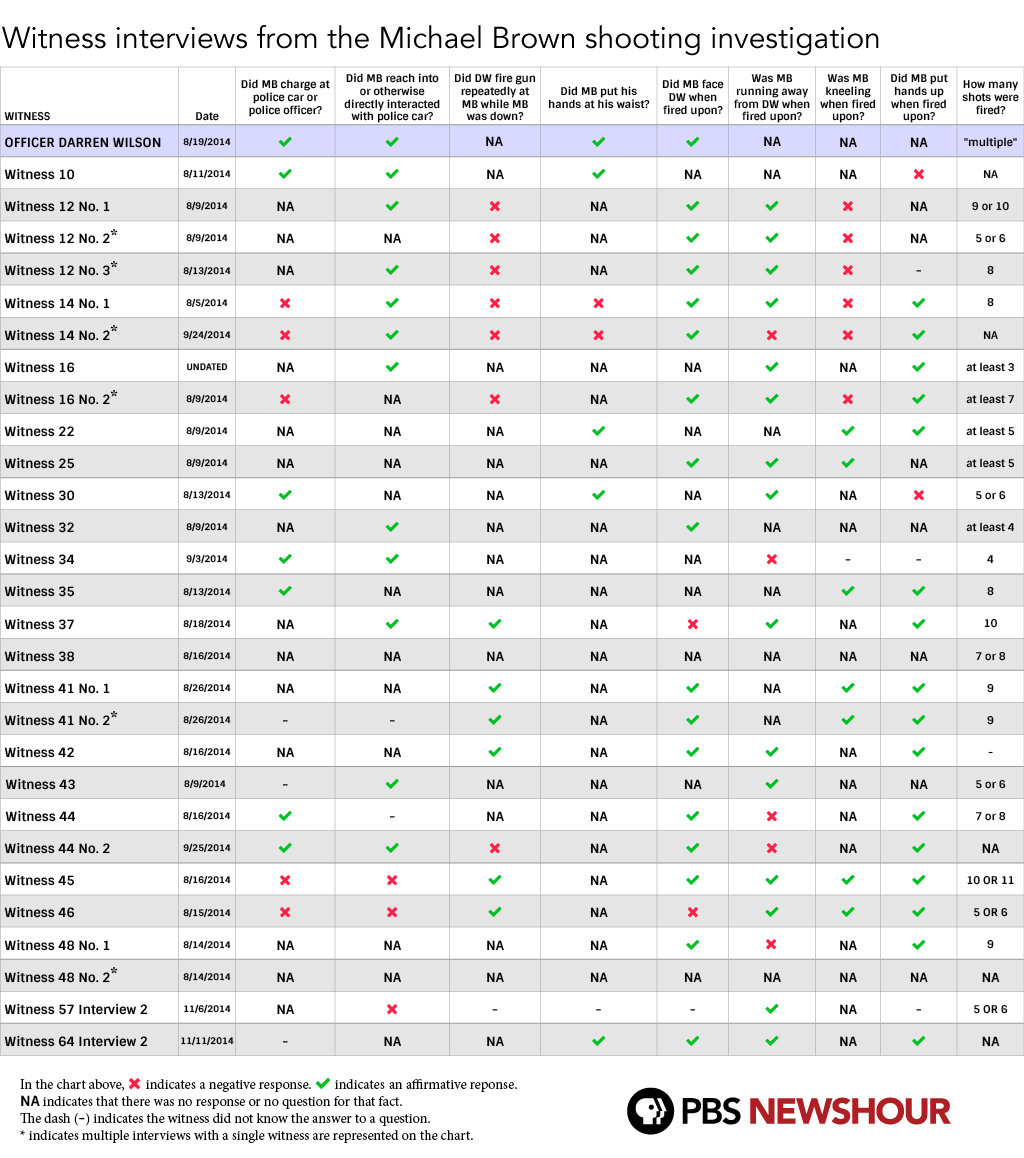 “Over the course of the investigation, federal agents interviewed dozens of witnesses—some compelled to come forward by subpoena—to piece together what happened on that August 9 afternoon. Shortly after the press conference announcing the jury’s decision, St. Louis County Prosecuting Attorney Robert McCulloch released the transcripts of interviews with witnesses and Wilson.
We read and analyzed more than 500 pages of witness testimony and compared each statement to those given by Wilson. Below is a chart comparing several key details of the officer’s report to the witness statements. Was Brown facing Wilson when he was shot, or was his back turned to him? Did Brown have his hands in the air, or were they reaching toward his waist?”
http://www.pbs.org/newshour/updates/newly-released-witness-testimony-tell-us-michael-brown-shooting/
“In the wake of public tragedy there is a space between the official narrative and the stories of the people who experienced it. Today, we crawl inside that space and question the role of journalists in helping us move on from a traumatic event.
NPR’s East Africa correspondent Gregory Warner takes us back to the 2013 terrorist attacks on the Westgate Mall in Nairobi, Kenya. Warner reported on the attack as it happened, listening to eyewitness accounts, sorting out the facts, establishing the truth. But he’s been been wrestling with it ever since as his friends and neighbors try not only to put their lives back together, but also try to piece together what really happened that day.”
http://www.radiolab.org/story/outside-westgate/
I made a shorter version of this podcast to play in class:
“A man creates a strange system to help him remember things; so he can hunt for the murderer of his wife without his short-term memory loss being an obstacle.”
“A heinous crime and its aftermath are recalled from differing points of view.”
“The investigators say there is no evidence in the wreckage or on the flight recorders of an in-flight fire or explosion. A plane breaking up in flight, as this one did, might in its last moments produce flashes of fire from engines ripping loose, but the idea that the plane caught fire is a trick of memory, they say.”
 “This series of 3D printed sculptures was designed in such a way that the appendages match Fibonacci’s Sequence, a mathematical sequence that manifests naturally in objects like sunflowers and pinecones. When the sculptures are spun at just the right frequency under a strobe light, a rather magical effect occurs: the sculptures seem to be animated or alive! The rotation speed is set to match with the strobe flashes such that every time the sculpture rotates 137.5º, there is one corresponding flash from the strobe light.”
“All mammals – including, probably, humans – have a global positioning system in their brains, which consists of at least three different cellular components. John O’Keefe, a neuroscientist at University College London, discovered the first component of the brain’s GPS in 1971. While recording nerve cell activity in the hippocampus of freely moving rats, he found neurons that fire only when the animals are in a specific area of their enclosure, and speculated that these ‘place’ cells play an important role in creating mental maps of the environment.”
http://www.theguardian.com/science/neurophilosophy/2014/dec/03/3d-compass-cells-bat-brain
3 links, the first to a news article, the second to a youtube video, and the third to a chapter in a podcast, This American Life, about this amazing man.
http://www.cnn.com/2011/11/09/tech/innovation/daniel-kish-poptech-echolocation/
http://www.thisamericanlife.org/radio-archives/episode/544/batman?act=1
 TOK Topics