The Case Against Perfection
January 29, 2015
“What’s wrong with designer children, bionic athletes, and genetic engineering.”
http://www.theatlantic.com/magazine/archive/2004/04/the-case-against-perfection/302927/
“What’s wrong with designer children, bionic athletes, and genetic engineering.”
http://www.theatlantic.com/magazine/archive/2004/04/the-case-against-perfection/302927/
Here is a link to a basic outline of an ethical theory of when wars can be considered just or moral.
“The story began in January 1951, when Mrs. Lacks was found to have cervical cancer. She was treated with radium at Johns Hopkins, the standard of care in that day, but there was no stopping the cancer. Her doctor had never seen anything like it. Within months, her body was full of tumors, and she died in excruciating pain that October. She was 31 and left five children, the youngest just a year old. She had been a devoted mother, and the children suffered terribly without her.”
“The trappings of science, anyway. Even in its day, many people saw that eugenics was a dubious discipline, riddled with inconsistencies. But it was championed by a very prominent and respected biologist, Charles Davenport, and its conclusions told many people what they wanted to hear: that certain “racial stock” was superior to others in such traits as intelligence, hard work, cleanliness, and so on. In this view of human behavior, the work of Sigmund Freud was disregarded, while the ideas of behaviorism were just gaining ground.”
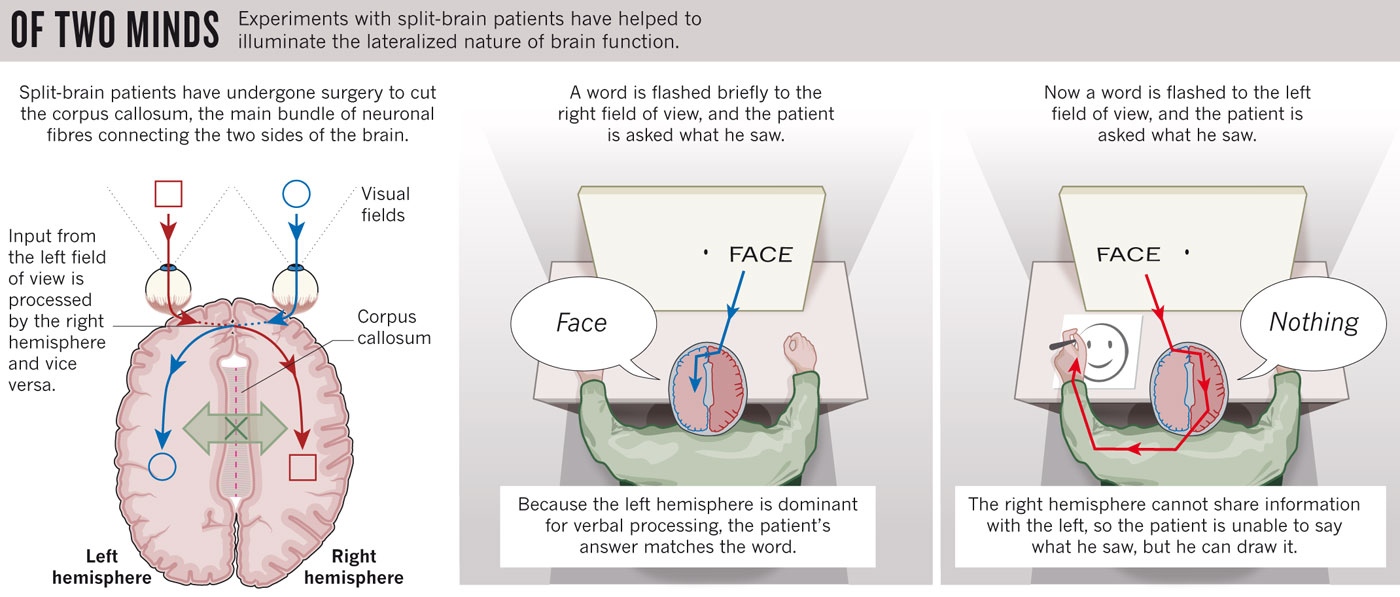 “Since the 1960s, researchers have been scrutinizing a handful of patients who underwent a radical kind of brain surgery. The cohort has been a boon to neuroscience — but soon it will be gone.”
http://www.nature.com/news/the-split-brain-a-tale-of-two-halves-1.10213
An interesting episode that delves into the meaning of words and what gives them power. Who gets to decide what a word means? What determines whether a word is insulting?
A thought provoking episode but there is a lot of foul language. The episode makes its point in the way that South Park usually does. If you can tolerate obscenity and offensive language, you might find this interesting.
https://www.cc.com/video/prdntl/south-park-south-park-1312-the-f-word-act-1
“Rock-star physicist” Brian Cox talks about his work on the Large Hadron Collider at CERN. Discussing the biggest of big science in an engaging, accessible way, Cox brings us along on a tour of the massive project.”
This is just an amazing lecture with some great visuals to help explain some complex ideas. Absolutely worth watching. Some interesting questions that get raised: Why bother engaging in research that is so far removed from any seeming relevance to our every day lives? Should we spend billions of dollars to fund research that may never provide any practical outcomes or make our lives materially any better? Is the quest for knowledge and understanding a valuable enough goal to justify these costs?
This lecture was filmed before the supercollider went online in 2008. It has since gone online and done some important work already and the particle he talks about, the Higgs Boson, has since been detected by the super collider as documented in the amazing documentary Particle Fever
“Statistics—the mathematical science of analyzing numerical information—is vital to the practice of all the empirical sciences. No modern science tries to account for the complexity of nature without using statistical methods, which typically provide investigators with a numerical outcome along with an analysis of the margin of accuracy of that outcome. With the help of computers, statistical techniques for collecting and analyzing large, complicated data sets have become very sophisticated and have proved to be reliable and effective for scientific researchers, inventors, and engineers working on problems in such diverse fields as economics, physics, and pharmaceuticals.”
“There is a growing concern that the rise in the popularity of basketball analytics (such as player efficiency rating and true shooting percentage) has led to more stat-based personnel hires rather than ex-players becoming general managers.”
“For as often as we hear about murders, the suicide rate is actually much higher than the homicide rate. Nearly a third more people die at their own hands than at other people’s (the murder rate in America is about 6 per 100,000; for suicides it’s about 10.8).”
http://news.discovery.com/human/psychology/suicide-a-more-present-threat-than-murder-130823.htm
 TOK Topics