Movie: 12 Angry Men
February 22, 2015
“A dissenting juror in a murder trial slowly manages to convince the others that the case is not as obviously clear as it seemed in court.”
“A dissenting juror in a murder trial slowly manages to convince the others that the case is not as obviously clear as it seemed in court.”
Below are some links about the debate between Bill Nye and Ken Ham from early 2014 about whether evolution or creationism better explains life on Earth.
Some interesting questions emerge from this debate. How do proponents of evolution and creationism approach knowledge and truth differently? This can be extended to the natural science and religious knowledge systems. Both look to find answers and truth and construct knowledge in fundamentally different ways. The two articles get into this issue a bit. You can watch the debate itself, it’s a bit long but worth watching at least a little bit.
1.Why Bill Nye Won the Creationism Debate Last Night
http://www.motherjones.com/blue-marble/2014/02/bill-nye-ken-ham-evolution-creationism-refuted
2. Bill Nye v Ken Ham: should scientists bother to debate creationism?
The public debate between Bill Nye and the president of a US creationist museum gives creationism a scientific legitimacy that it isn’t entitled to
3.Bill Nye versus Ken Ham: Who won?
http://www.csmonitor.com/Science/2014/0205/Bill-Nye-versus-Ken-Ham-Who-won-video
“Rarely does anyone weigh facts before deciding what to believe.”
“Scientists and their work have an important place in every major aspect of American life.
Many hope that advances in science will improve people’s lives and enhance the economy. They are anxious to understand what innovations will disrupt existing daily activities and business routines. Policy arguments about science-related issues have held center stage in the Obama era, starting with the protracted arguments over medical care, insurance and the Affordable Care Act and extending into every cranny of energy and environmental concerns, policies around food, challenges created by digital technology disruptions, and whether educators are preparing today’s K-12 students for a future with greater requirements for science literacy and numeracy.”
Below is a link to a letter signed by a large number of climate scientists about the reality of climate change. One provocative statement they make in defense of their work and against climate change skeptics is that “There is always some uncertainty associated with scientific conclusions; science never absolutely proves anything.”
This letter caused a stir among other scientists, some of whom wrote and signed another letter making the argument that: “There is no reason to doubt the laws of physics governing acceleration and momentum. These laws are the basis for a large number of industrial operations, transportation and numerous other activities.”
An interesting exchange that gets to the nature of science and scientific knowledge.
Original letter:
http://www.skepticalscience.com/Climate-Change-and-the-Integrity-of-Science-a-letter-to-Science.html
Response:
One of my favorite TED Talks.
“What does real scientific work look like? As neuroscientist Stuart Firestein jokes: It looks a lot less like the scientific method and a lot more like “farting around … in the dark.” In this witty talk, Firestein gets to the heart of science as it is really practiced and suggests that we should value what we don’t know — or “high-quality ignorance” — just as much as what we know.”
Here is a link to an amazing document written in the early 2000’s by Republican strategist Frank Luntz to help Republican politicians frame the debate about the War on Terror, the Iraq war, security and other related issues. This document helped communicate and sell to the public ideas that may not have been true. Without actually saying things that were false, they left people with the impression of false information. Members of the Republican party were amazingly effective at being on the same page as each other and really used a lot of the same language as laid out in this document.
How does language help us communicate? Is it unethical to mislead your audience without ever uttering something untruthful?
In 2011, the state of Illinois increased its state income tax rate from 3% to 5%. One could communicate this by saying that people will be paying 2% more of their incomes to state taxes which doesn’t sound all that bad since Illinois increased its rate rate 2%. Or you could say that Illinois increased its state income tax by 66% which sounds catastrophic and is also correct because you’re changing what the number actually is referring to. Increasing from 3 to 5 is an increase of 66% (or 66.6% to be more accurate with a bar over the last 6 but I don’t know how to do that on a keyboard). People would react to the news differently depending on how you communicate even though both could be considered correct.
Here are two different sites reporting the story. Notice how the choice of language and numbers changes the feel of each story even though they are both reporting the same news.
http://www.cleveland.com/nation/index.ssf/2011/01/illinois_legislators_increase.html
http://www.foxnews.com/politics/2011/01/12/ill-lawmakers-pass-percent-income-tax-increase/
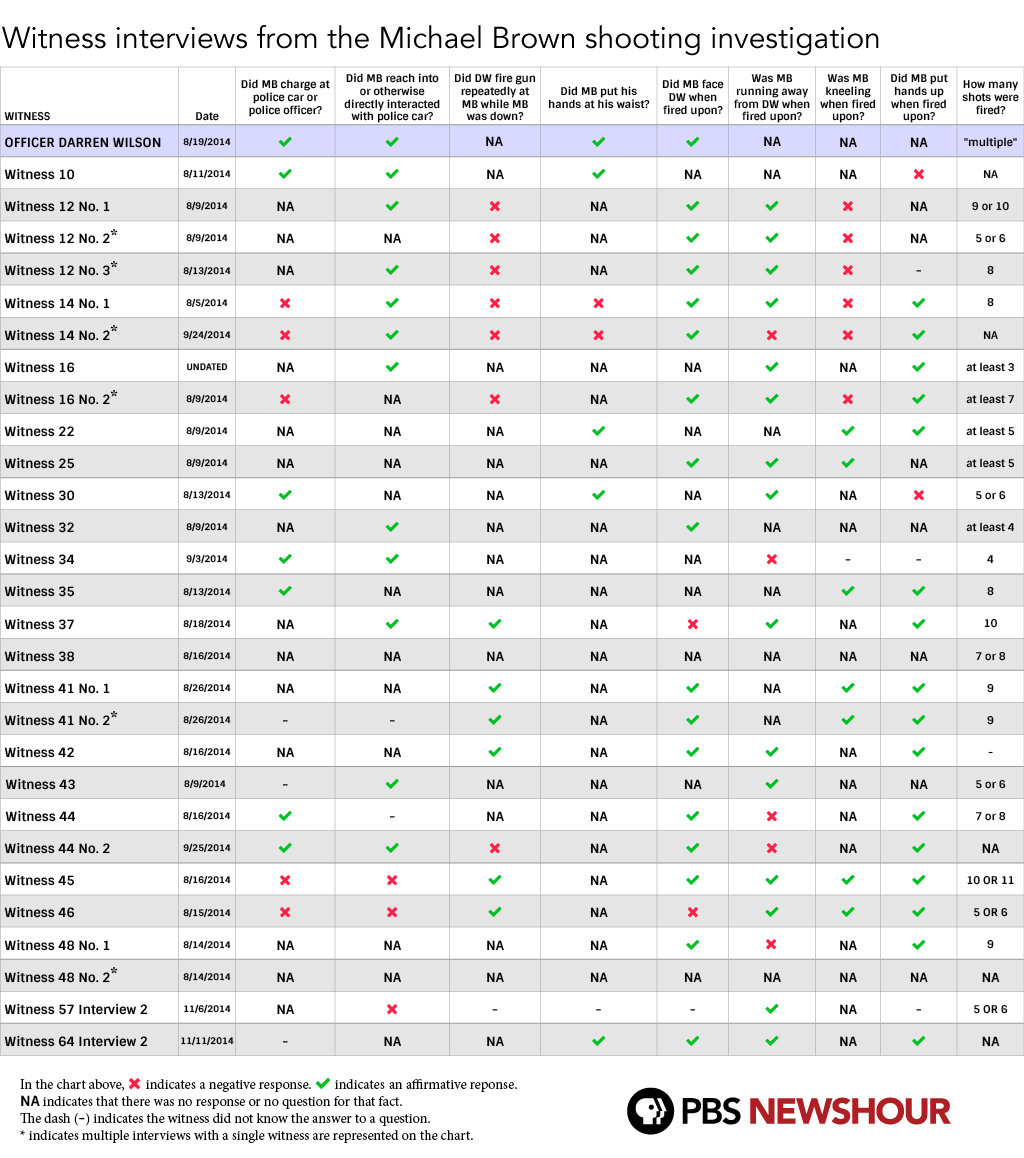 “Over the course of the investigation, federal agents interviewed dozens of witnesses—some compelled to come forward by subpoena—to piece together what happened on that August 9 afternoon. Shortly after the press conference announcing the jury’s decision, St. Louis County Prosecuting Attorney Robert McCulloch released the transcripts of interviews with witnesses and Wilson.
We read and analyzed more than 500 pages of witness testimony and compared each statement to those given by Wilson. Below is a chart comparing several key details of the officer’s report to the witness statements. Was Brown facing Wilson when he was shot, or was his back turned to him? Did Brown have his hands in the air, or were they reaching toward his waist?”
http://www.pbs.org/newshour/updates/newly-released-witness-testimony-tell-us-michael-brown-shooting/
“The investigators say there is no evidence in the wreckage or on the flight recorders of an in-flight fire or explosion. A plane breaking up in flight, as this one did, might in its last moments produce flashes of fire from engines ripping loose, but the idea that the plane caught fire is a trick of memory, they say.”
 TOK Topics