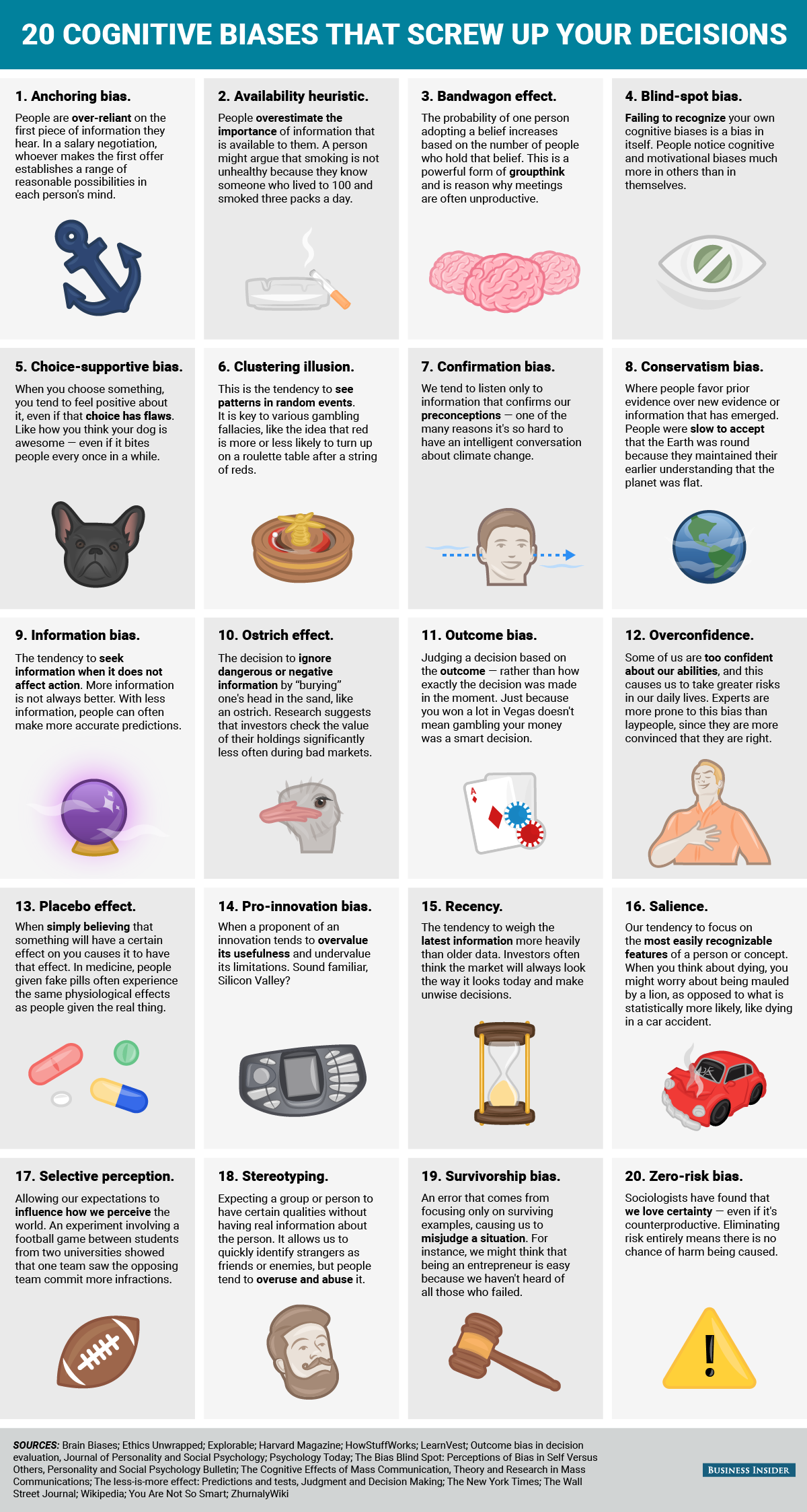
20 cognitive biases that screw up your decisions
October 14, 2015
“Today, the notion of ‘smart-thinking’ is ubiquitous. This huge publishing field was prefigured by the work of social psychologist Richard Nisbett who in 1977 published an empirically researched article that showed that many of our choices and preferences are influenced by factors outside our conscious awareness. This was ground-breaking and it became one of the most cited articles of the decade. Nisbett, who is Theodore M. Newcomb Distinguished Professor of social psychology and co-director of the Culture and Cognition programme at the University of Michigan, has published numerous books over his long career. The latest isMindware: Tools for Smart Thinking. Here, he discusses some of his ideas.”
An interesting article that approaches this question by examining the role of religious dictates, moral philosophies, reason, natural science among other point of view.
“Moral disputes seem intractable — more intractable than other disputes. Take an example of a moral position that most of us would consider obvious: Honor killing is wrong. But honor killing has its supporters. Anyone who suggests that we can compromise with its supporters on the matter misunderstands the nature of this type of disagreement. It’s absolute. One party has to be right. Us. So why can’t we convince those who hold the opposite view?”
http://opinionator.blogs.nytimes.com/2015/07/13/can-moral-disputes-be-resolved/
“That a person with such everyday flaws has scaled the unforgiving heights of the economics establishment is striking in itself. Even more so is the fact that he has done so by turning those weaknesses into the very subject of a new branch of economic science. Thaler has spent a career seeking to understand individuals as they really are – chock-full of weaknesses, irrationalities and idiosyncrasies. He labels these creatures ‘humans’, rather than as ‘econs’, walking calculators rationally optimising their utility.”
“In his provocative new book, evolutionary biologist Jerry A. Coyne lays out in clear, dispassionate detail why the toolkit of science, based on reason and empirical study, is reliable, while that of religion—including faith, dogma, and revelation—leads to incorrect, untestable, or conflicting conclusions.
“Coyne is responding to a national climate in which over half of Americans don’t believe in evolution (and congressmen deny global warming), and warns that religious prejudices and strictures in politics, education, medicine, and social policy are on the rise. Extending the bestselling works of Richard Dawkins, Daniel Dennett, and Christopher Hitchens, he demolishes the claims of religion to provide verifiable “truth” by subjecting those claims to the same tests we use to establish truth in science.”
http://www.amazon.com/Faith-Versus-Fact-Religion-Incompatible/dp/0670026530/ref=cm_wl_huc_item
“A new book by the evolutionary biologist Jerry Coyne tackles arguments that the two institutions are compatible.
“In the book’s 262 pages, Coyne tackles arguments stating that belief in God is a laudable quality, and reasons instead that faith is detrimental, even dangerous, and fundamentally incompatible with science, even while peacemakers try to find common ground between the two. Coyne, it should be noted, has spent much of his career objecting to religious rejection of Darwinism—he published a bestseller, Why Evolution Is True, that was based on his blog of the same name. In Faith Versus Fact, his overarching argument is that religion and science both make claims about the universe, but only one of the two institutions is sufficiently open to the fact that it might be wrong.
“Hiring and recruiting might seem like some of the least likely jobs to be automated. The whole process seems to need human skills that computers lack, like making conversation and reading social cues.
“But people have biases and predilections. They make hiring decisions, often unconsciously, based on similarities that have nothing to do with the job requirements — like whether an applicant has a friend in common, went to the same school or likes the same sports.”
“Scientists disagree vigorously with one another as they attempt to build the case for new advancements; this peer review is the heart of the scientific process, one of the tools and techniques scientists have developed to encourage the flow of good ideas and sift out bad one. Unfortunately, Dr. Chopra chooses to circumvent that path, publishing his claims as self-help books rather than subjecting them to the rigors of scientific review.”
And a second related article
“The geography shaped the way people interacted with one another. In ancient Greece, one could decide to move his goat heard with little consideration of what other people thought — unless his livestock invaded somebody else’s property. But, if in ancient China, one were to make the most of his rice harvest, he’d need cooperation from neighbors.”
http://finance.yahoo.com/news/fascinating-cultural-reason-why-westerners-162722303.html
 TOK Topics