The New York Times’s false equivalency problem, in one paragraph

“Bias incidents on both sides have been reported. A student walking near campus was threatened with being lit on fire because she wore a hijab. Other students were accused of being racist for supporting Mr. Trump, according to a campuswide message from Mark Schlissel, the university’s president.”

http://www.vox.com/policy-and-politics/2016/12/8/13891648/new-york-times-false-equivalence

Freakonomics Podcast: Bad Medicine, Parts 1, 2, and 3: The Story of 98.6, Drug Trials, and Death Diagnosis

Part I:

“We tend to think of medicine as a science, but for most of human history it has been scientific-ish at best. In the first episode of a three-part series, we look at the grotesque mistakes produced by centuries of trial-and-error, and ask whether the new era of evidence-based medicine is the solution.”

http://freakonomics.com/podcast/bad-medicine-part-1-story-98-6/

Part II:

“How do so many ineffective and even dangerous drugs make it to market? One reason is that clinical trials are often run on “dream patients” who aren’t representative of a larger population. On the other hand, sometimes the only thing worse than being excluded from a drug trial is being included.”

http://freakonomics.com/podcast/bad-medicine-part-2-drug-trials-and-tribulations/

Part III:

“By some estimates, medical error is the third-leading cause of death in the U.S. How can that be? And what’s to be done? Our third and final episode in this series offers some encouraging answers.”

http://freakonomics.com/podcast/bad-medicine-part-3-death-diagnosis/

Our world is awash in bullshit health claims. These scientists want to train kids to spot them.

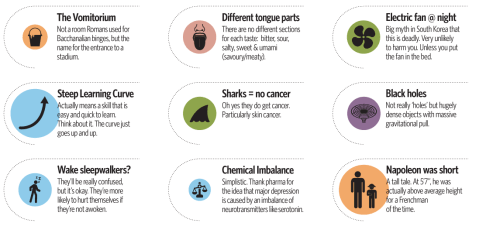
Screen Shot 2016-09-28 at 10.07.44 AM.png

“We are trying to teach children that stories are usually an unreliable basis for assessing the effect of treatments,” Nsangi explained, adding that stories amount to anecdotal evidence. The kids are also learning to watch out for the perverting effects of conflicts of interest, and to recognize that all treatments carry both harms and benefits and that large, dramatic effects from a treatment are really, really rare.

https://www.vox.com/2016/10/6/13079754/teaching-critical-thinking-schools-health-claims

SCIENTISTS: EARTH ENDANGERED BY NEW STRAIN OF FACT-RESISTANT HUMANS

“While scientists have no clear understanding of the mechanisms that prevent the fact-resistant humans from absorbing data, they theorize that the strain may have developed the ability to intercept and discard information en route from the auditory nerve to the brain. “The normal functions of human consciousness have been completely nullified,” Logsdon said.”

http://www.newyorker.com/humor/borowitz-report/scientists-earth-endangered-by-new-strain-of-fact-resistant-humans

Can We Think Critically Anymore?

“The Internet might very well have been designed for confirmation bias. If you have a theory, you’ll find some site purporting it to be true. (I’m constantly amazed at how many people post Natural News stories on my feed, as if anything on the site is valid.) Levitin notes that MartinLutherKing.org is run by a white supremacist group. Even experts get fooled: Reporter Jonathan Capehart published a Washington Post article “based on a tweet by a nonexistent congressman in a nonexistent district.””

http://bigthink.com/21st-century-spirituality/can-we-think-critically-anymore?mc_cid=38a162efbc&mc_eid=34e2887073

Why News Junkies Are So Glum About Politics, Economics, and Everything Else Stock-market crashes, terrorist attacks, and the dark side of “newsworthy” stories

“The rule is straightforward, but its implications are subtle. If journalists are encouraged to report extreme events, they guide both elite and public attitudes, leading many people, including experts, to feel like extreme events are more common than they actually are. By reporting on only the radically novel, the press can feed a popular illusion that the world is more terrible than it actually is.”

http://www.theatlantic.com/business/archive/2016/07/why-news-junkies-get-are-so-glum-about-politics-economics-and-everything-else/492989/?mc_cid=374abf3cdb&mc_eid=34e2887073

How social media can distort and misinform when communicating science

Interesting article about how we acquire and spread information. How we close ourselves off to voices we disagree with and how the frequency with which information is shared is not necessarily validation of its truthfulness.

“The problem is that social media is also a great way to spread misinformation, too. Millions of Americans shape their ideas on complex and controversial scientific questions – things like personal genetic testing, genetically modified foods and their use of antibiotics – based on what they see on social media. Even many traditional news organizations and media outlets report incomplete aspects of scientific studies, or misinterpret the findings and highlight unusual claims. Once these items enter into the social media echo chamber, they’re amplified. The facts become lost in the shuffle of competing information, limited attention or both.”

https://theconversation.com/how-social-media-can-distort-and-misinform-when-communicating-science-59044?mc_cid=6e8e6bd94e&mc_eid=34e2887073