Is There such a Thing as Scientific Objectivity?

“This story has much to say about the nature of scientific knowledge. It is not, as we so often think, a collection of objective facts and unbiased observations that sprout in hermetically sealed environments, unsullied by human minds and hands. “On closer analysis,” writes science historian Paul Feyerabend, “we even find that science knows no ‘bare facts’ at all, but that all the ‘facts’ that enter our knowledge are already viewed in a certain way.” Facts come clothed in history, colored by context. Science is less a statement of truth than a running argument. As it turns out, the scientific method isn’t so “scientific” after all.”
https://tok2012.wikispaces.com/Scientific+Objectivity

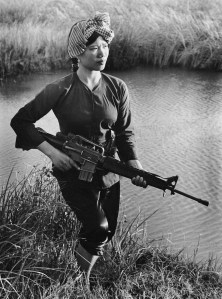
1965-1975 Another Vietnam Unseen images of the war from the winning side

NGS3475 161A
NGS3475 161A

How do these images illustrate the role that perspective plays when it comes to knowledge? When it comes to learning about History?

“For much of the world, the visual history of the Vietnam War has been defined by a handful of iconic photographs: Eddie Adams’ image of a Viet Cong fighter being executed, Nick Ut’s picture of nine-year-old Kim Phúc fleeing a napalm strike, Malcolm Browne’s photo of Thích Quang Duc self-immolating in a Saigon intersection.

“Many famous images of the war were taken by Western photographers and news agencies, working alongside American or South Vietnamese troops.

“But the North Vietnamese and Viet Cong had hundreds of photographers of their own, who documented every facet of the war under the most dangerous conditions.”

http://mashable.com/2016/02/05/another-vietnam-photography/#.vGRaZ2NPkqi

‘Map: Exploring the World,’ ‘The Curious Map Book’ and More

“What is it about maps that we find so fascinating? Ever since the Babylonians scratched two parallel lines and a circle — representing the Euphrates River and their walled capital — on a clay tablet almost 3,000 years ago, we humans have been producing flat spatial imagery to locate our place in the world. Maps anchor us, give coherence to our environment, help make visual sense of otherwise intangible realities. The most skillfully done maps, moreover, can be thrilling to look at, elevating cartography into art.”

http://mobile.nytimes.com/2015/12/06/books/review/map-exploring-the-world-the-curious-map-book-and-more.html?smid=tw-nytbooks&smtyp=cur&_r=1&referer=https://t.co/CyIJpyNFrJ


America’s First Slavery Museum Shifts the Focus from Masters to Slaves

What roles does perspective play in learning history? How might we think of the institution of slavery differently if we focused on the experiences of those who were enslaved rather than the experiences of their masters?

“The entire museum is similar: You walk the same pathways that victims of chattel slavery walked, you listen to their stories in their own words, you see and hear the pieces of history that aren’t printed in textbooks or told on other plantation tours. You won’t find much information on the wealthy slaveowners on this plantation. Instead, Whitney presents slavery through the stories of those who experienced it.”

http://www.vice.com/read/americas-first-slavery-museum-shifts-the-focus-from-masters-to-slaves-511?utm_source=vicetwitterus

Rethinking History Class on Columbus Day: The importance of exposing students to the many truths about the controversial explorer

“The moment was one of realization and appreciation as his daughter explained in her child-like way what Ryan conveys to his high school students: Interpreting history is hard. He then posed his final question that’s the source of heated and tense debates every year.

“Do you think we should celebrate Columbus Day in our country?”

And with a simple innocence yet profound insight that belies her age, the first-grader answered, “Yes, but we should tell the truth.  Not everyone liked Columbus.””

http://www.theatlantic.com/education/archive/2015/10/columbus-day-school-holiday/409984/?mc_cid=bed065a83a&mc_eid=34e2887073

One woman’s mission to photograph every Native American tribe in the US

What does this article tell us about the power of culture and imagery in shaping our perceptions of various groups of people? To what degree can those perceptions be changed? Is it wrong to propagate false or inaccurate representations? This connects to the debate about sports mascots to some degree.

“Matika Wilbur has traveled more than 250,000 miles to ensure stereotyped images are replaced with accurate ones to change history’s collective psyche.”

“A search for Native Americans on the internet yields almost nothing but reductionist, 18th-century representations of a ‘feathered and leathered people’, Wilbur says. She hopes the pictures she’s taking can someday replace the stereotyped, dated ones found in internet searches, and the ones we hold on to in our collective psyche.

“‘I’m ultimately doing this because our perception matters,’ she says. ‘Our perception fuels racism. It fuels segregation. Our perception determines the way we treat each other.'”

http://www.theguardian.com/us-news/2015/sep/07/native-american-photographs-matika-wilbur-project-562?hash=105388b0-c278-4722-9bb6-2b2df05942bb

Who’s the Bad Guy? The View on Foreign Policy From Tehran

“In the Western view, an aggressive Iran seeks to create a Shia Crescent under its control, stretching from Lebanon through Syria, Iraq, and into Bahrain and Yemen.

“The US, Britain, Israel, and other Western powers point at Iran providing arms to the Lebanese group Hezbollah and Syrian President Bashar al-Assad, backing Houthi rebels in Yemen, and controlling some Shia militias in Iraq.

“Yet Iranians see their national security in exact opposite terms. They are the victims and the West supports terrorism. As a result of wars in Afghanistan and Iraq, the US has stationed troops in countries along Iran’s borders. The US backs Saudi Arabia’s aggressive actions against the Houthis in Yemen.

“According to this view, the West has laid the ground work for turning Syria into a failed state. Any arms shipments or political support offered by Iran is purely in self-defense, according to Iranian officials.”

https://news.vice.com/article/whos-the-bad-guy-the-view-on-foreign-policy-from-tehran

Rashomon on the West Bank: Israelis and Palestinians Debate Images of Soldier and Child

01open_headlock-articleLarge

“Despite broad agreement about the central facts — a spokeswoman for the Israel Defense Forces said that the soldier “attempted to detain an individual who had been identified as throwing rocks” and was foiled; the boy’s mother, who participated in the struggle to free him, said he had been throwing rocks — there is an intense debate about what, precisely, the images convey about the Israeli military occupation of this territory, which has now lasted nearly five decades.

“Supporters of the Palestinian cause say the images of an armed soldier placing a 12-year-old boy with a cast on his arm in a headlock is important evidence of what they call the brutality of life under military rule.

“Many Israelis, including some senior officials, concurred with domestic media accounts that depicted the soldier as showing great restraint as the victim of a violent attack by the female protesters.”

http://www.nytimes.com/2015/09/02/world/middleeast/rashomon-on-the-west-bank-israelis-and-palestinians-debate-images-of-soldier-and-child.html?ribbon-ad-idx=6&rref=collection/column/open-source