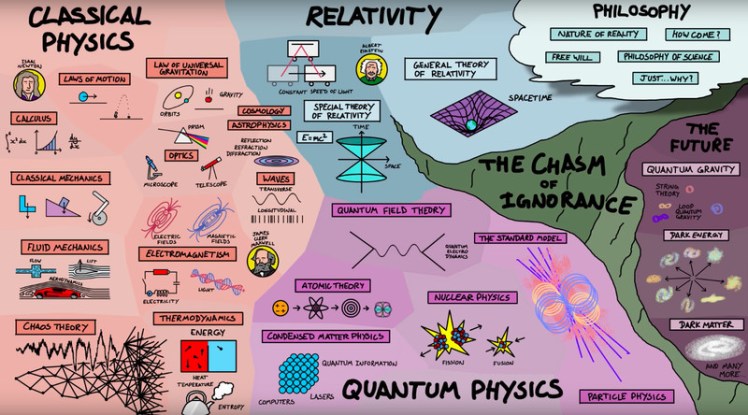
Physics has a dizzying array of subdisciplines. This short video breaks it down.

How does scientific knowledge progress? What are the implications and consequences of this progress? How does this “map” of scientific knowledge accurately represent underlying reality?

Science Fields

“As Walliman’s animation shows, there’s still a giant “chasm of ignorance” that scientists are seeking to fill. Even though scientists now know a lot about things like optics, thermodynamics, fluid mechanics, and electromagnetism, their tested theories still can’t explain things like dark matter and dark energy. And there’s no complete theory that squares quantum physics with relativity.”

https://www.vox.com/science-and-health/2016/11/29/13769152/physics-subdiscipline-video

Soon We’ll Cure Diseases With a Cell, Not a Pill | Siddhartha Mukherjee | TED Talks

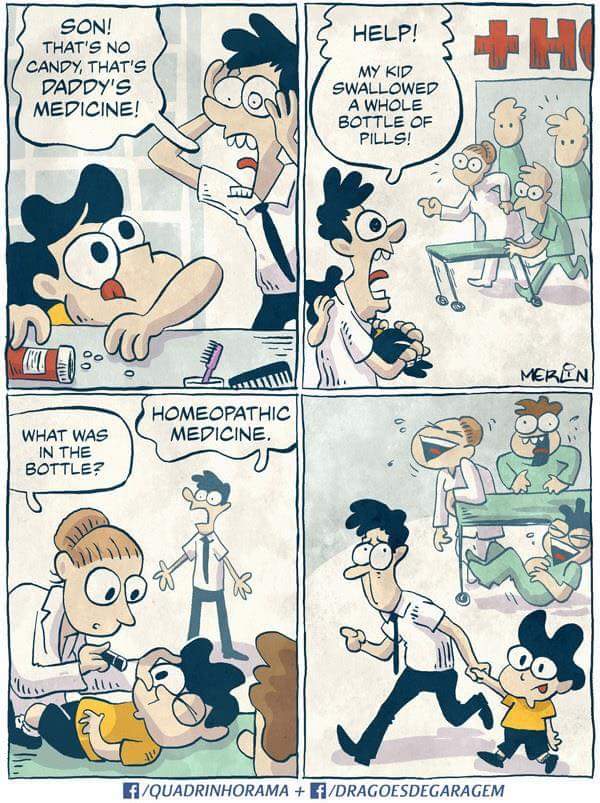
How are models used in medicine? How does a faulty or limited model negatively impact our approaches to treating the human body? Really great TED talk about these questions

Current medical treatment boils down to six words: Have disease, take pill, kill something. But physician Siddhartha Mukherjee points to a future of medicine that will transform the way we heal.

Science vs. Humanities in 3 Rounds. Steven Pinker and Leon Wieseltier discuss.

Science Is Not Your Enemy: An impassioned plea to neglected novelists, embattled professors, and tenure-less historians

Though everyone endorses science when it can cure disease, monitor the environment, or bash political opponents, the intrusion of science into the territories of the humanities has been deeply resented. Just as reviled is the application of scientific reasoning to religion; many writers without a trace of a belief in God maintain that there is something unseemly about scientists weighing in on the biggest questions. In the major journals of opinion, scientific carpetbaggers are regularly accused of determinism, reductionism, essentialism, positivism, and worst of all, something called “scientism.”

https://newrepublic.com/article/114127/science-not-enemy-humanities

Crimes Against Humanities: Now science wants to invade the liberal arts. Don’t let it happen.

The question of the place of science in knowledge, and in society, and in life, is not a scientific question. Science confers no special authority, it confers no authority at all, for the attempt to answer a nonscientific question. It is not for science to say whether science belongs in morality and politics and art. Those are philosophical matters, and science is not philosophy, even if philosophy has since its beginnings been receptive to science. Nor does science confer any license to extend its categories and its methods beyond its own realms, whose contours are of course a matter of debate.

https://newrepublic.com/article/114548/leon-wieseltier-responds-steven-pinkers-scientism

Science vs. the Humanities, Round III

Wieseltier bristles at my suggestion that science is distinguished by the value it places on the thorough-going intelligibility of the world—on the relentless search beyond the explanation of a phenomenon for a still deeper explanation of the explicans. Yet he legislates that the humanities may tolerate no such curiosity.

https://newrepublic.com/article/114754/steven-pinker-leon-wieseltier-debate-science-vs-humanities

H.G. Wells vs. George Orwell: Their Debate Whether Science Is Humanity’s Best Hope Continues Today


“In 2013, biologist Richard Dawkins justified confidence in science in these terms: “Science works. Planes fly. Cars drive. Computers compute. If you base medicine on science, you cure people. If you base the design of planes on science, they fly. It works….” On the other hand, Nobel laureate Peter Medawar famously argued that there are many important questions that science cannot answer, such as, “What is the purpose of life?” and “To what uses should scientific knowledge be put?”

“Confronting challenges such as climate change and feeding the 2 billion people who lack a reliable source of food, it might be natural to regard science as humanity’s only hope. But expecting from science what it cannot deliver is just as hazardous as failing to acknowledge its great potential.”

https://www.scientificamerican.com/article/h-g-wells-vs-george-orwell-their-debate-whether-science-is-humanitys-best-hope-continues-today/

Are genetically modified foods safe? Science says yes but why do so many people still believe otherwise?

Currently, thousands of plants and animals grown and raised in the United States have been genetically modified in some way. Since the beginnings of agriculture and animal husbandry, humans have been manipulating the genetics of plants and animals but what’s different now is that we have the ability to successfully and effectively splice genes from one species into another. Sometimes DNA from a bacterium has a property that is effective when added to the genome of corn. Once this DNA is added, the corn is considered “genetically modified” or a genetically modified organism (GMO). (Click here for more information on what a GMO is)

Rigorous scientific studies have consistently shown that GM foods are as safe to consume as their non GM counterparts however fears about their safety persist. Why is that? To get to the heart of the issue we have to examine the role of language in our acquisition of knowledge, the relationship between emotion and reason when making decisions about our health, and standards of good science.

The Inquiry Podcast: Is the Knowledge Factory Broken?

This podcast examines the nature of scientific knowledge and how it is produced. What is “good science” and how is it undermined by incentives and the process itself?

“Academic research stands accused of turning a blind eye to dodgy data, failing to reconcile contradictory findings and valuing money over knowledge. We examine the criticisms, which go the very heart of our pursuit of knowledge.”

http://www.bbc.co.uk/programmes/w3csvsy8

Why avoiding sunshine could kill you

“Researchers followed 30,000 women for 20 years and found that those who avoided the sunshine were twice as likely to die”

Despite the very sensational title, this is an interesting case to look it when understanding the nature and challenges of science. A simple look at the title might convince people that using sunblock or avoiding sunlight may be bad advice, however a more careful look at the study, its conclusions, and an understanding of the nature of scientific certainty should give us pause.

The study followed women in Sweden and, assuming the study was done properly, should only suggest conclusions dealing with a particular set of people: fair skinned women living in northern latitudes.

There may be a tendency to overextrapolate and think that all sunscreen is bad and all sunlight is good however that would be a premature and possibly detrimental conclusion.

Buried in the article linked below is an interesting sentence: “Women who sunbathed in the summer were also 10 per cent less likely to die from skin cancer although those who sunbathed abroad were twice as likely to die from melanoma.”

This study is not simply a study about sunlight vs. not sunlight but possibly about how much sunlight is appropriate.

Furthermore, the article states:

“The findings from Dr Lindqvist’s team are interesting, but it is possible that the women in the study who had high sun exposure differed from the women who had low sun exposure in ways that may explain their reduced cancer risk.”

Yinka Ebo, senior health information officer at Cancer Research UK, said striking a balance was important.

“The reasons behind higher death rates in women with lower sun exposure are still unexplained, as unhealthy lifestyle choices could have played a part,” she added.

This adds to the discussion of what it takes to prove something in the natural sciences and shows how challenging it is to build a scientific consensus. This just one study on a very specific group of people and still there are variables that are unknown.

http://www.telegraph.co.uk/news/science/science-news/10811734/Why-avoiding-sunshine-could-kill-you.html