Human cycles: History as science Advocates of ‘cliodynamics’ say that they can use scientific methods to illuminate the past. But historians are not so sure.

“What is new about cliodynamics isn’t the search for patterns, Turchin explains. Historians have done valuable work correlating phenomena such as political instability with political, economic and demographic variables. What is different is the scale — Turchin and his colleagues are systematically collecting historical data that span centuries or even millennia — and the mathematical analysis of how the variables interact.”

http://www.nature.com/news/human-cycles-history-as-science-1.11078
The Pursuit of Beauty: Yitang Zhang solves a pure-math mystery.

“The problem that Zhang chose, in 2010, is from number theory, a branch of pure mathematics. Pure mathematics, as opposed to applied mathematics, is done with no practical purposes in mind. It is as close to art and philosophy as it is to engineering. “My result is useless for industry,” Zhang said. The British mathematician G. H. Hardy wrote in 1940 that mathematics is, of “all the arts and sciences, the most austere and the most remote.” Bertrand Russell called it a refuge from “the dreary exile of the actual world.” Hardy believed emphatically in the precise aesthetics of math. A mathematical proof, such as Zhang produced, “should resemble a simple and clear-cut constellation,” he wrote, “not a scattered cluster in the Milky Way.” Edward Frenkel, a math professor at the University of California, Berkeley, says Zhang’s proof has “a renaissance beauty,” meaning that though it is deeply complex, its outlines are easily apprehended. The pursuit of beauty in pure mathematics is a tenet. Last year, neuroscientists in Great Britain discovered that the same part of the brain that is activated by art and music was activated in the brains of mathematicians when they looked at math they regarded as beautiful.”

http://www.newyorker.com/magazine/2015/02/02/pursuit-beauty

The Beauty of Bounded Gaps
A huge discovery about prime numbers—and what it means for the future of math.

http://www.slate.com/articles/health_and_science/do_the_math/2013/05/yitang_zhang_twin_primes_conjecture_a_huge_discovery_about_prime_numbers.html

Mathematicians are geeking out about a bizarre discovery in prime numbers

This article made me think about one of the recent TOK essay questions about the value of knowledge being limited if it does not have application in the world. This is an article about an interesting discovery about the properties of numbers that does not seem to have direct application in the world but still had many brilliant minds working on.

“As with anything to do with numbers, this bizarre pattern has always existed. The researchers only found it now because they went looking for it. Fortunately, the “anti-sameness” bias doesn’t yet have any practical implication on the rules of cryptography that underpin our important online transactions. But mathematicians are happy to be stumped. They have a new challenge to explain the phenomenon. As we know from historical examples, this hardy group of scholars won’t remain stumped for long.”

http://qz.com/639452/mathematicians-are-geeking-out-about-a-bizarre-discovery-in-prime-numbers/

Another article on the same subject.

https://www.newscientist.com/article/2080613-mathematicians-shocked-to-find-pattern-in-random-prime-numbers/

Tell us something we don’t know: why science can’t show us much about art

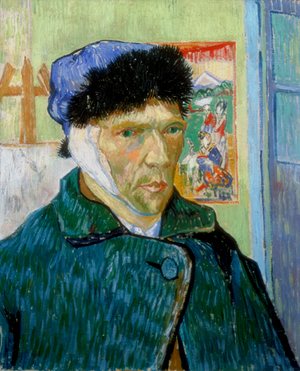
3762“The scientific ‘discovery’ that Van Gogh’s art changed after his 1888 breakdown proves a forensic approach is no match for the subjective eye of an art lover.

“There are objective results in science. There is no objective truth in art. It exists in our eyes and in our imaginations. I happen to agree with the research behind this latest Van Gogh investigation – that he got more strident and emotional in his art as his mental health declined – to the extent that I find the results obvious. But someone who has spent years looking at Van Gogh might disagree – she might see this as a melodramatic interpretation and argue that Van Gogh is not really an expressionist painter at all but a student of light and colour. That’s a valid point of view too, whatever the science says.

“Thanks to science, we know that we live on a rock orbiting a mediocre star in a mediocre galaxy. But we won’t ever invent a science that can tell us what Van Gogh’s painting Starry Night is about. The data lies hidden in our souls.”

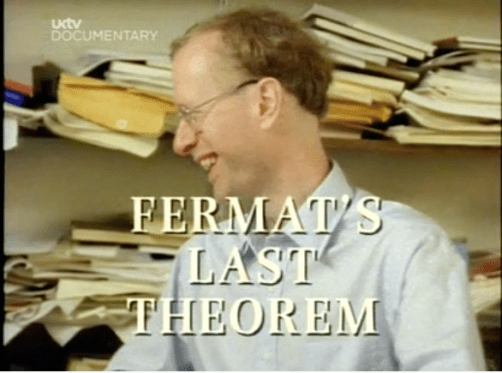
Video: Fermat’s Last Theorem

“In June 1993 he reached his goal. At a three-day lecture at Cambridge, he outlined a proof of Taniyama – and with it Fermat’s Last Theorem. Wiles’ retiring life-style was shattered. Mathematics hit the front pages of the world’s press. Then disaster struck. His colleague, Dr Nick Katz, made a tiny request for clarification. It turned into a gaping hole in the proof. As Andrew struggled to repair the damage, pressure mounted for him to release the manuscript – to give up his dream. So Andrew Wiles retired back to his attic. He shut out everything, but Fermat.”

(Click on the image to view documentary)

The unexpected math behind Van Gogh’s “Starry Night” – Natalya St. Clair

Physicist Werner Heisenberg said, “When I meet God, I am going to ask him two questions: why relativity? And why turbulence? I really believe he will have an answer for the first.” As difficult as turbulence is to understand mathematically, we can use art to depict the way it looks. Natalya St. Clair illustrates how Van Gogh captured this deep mystery of movement, fluid and light in his work.

Addicted to the Lottery: Why People Buy False Hope and Lottery Tickets

“States spend millions on promoting the lottery. In 2011, Oregon’s ad budget was $26.6 million over a two year period; in Ohio, the state used to time advertisements for its Super Lotto game to coincide with the delivery of Social Security and government benefit checks. Poor people are the primary targets of these campaigns—a fact that has made some of my interactions with lottery players uneasy. Multiple customers have told that they spend around $3,000 each year on the lottery and never win. Each person said they continue to play ‘because it’s fun.'”

http://www.vice.com/read/addicted-to-the-lottery-why-people-buy-false-hope-and-lottery-tickets-511?utm_source=vicetwitterus

Gamblers, Scientists and the Mysterious Hot Hand

“The opposite of that is the hot-hand fallacy — the belief that winning streaks, whether in basketball or coin tossing, have a tendency to continue, as if propelled by their own momentum. Both misconceptions are reflections of the brain’s wired-in rejection of the power that randomness holds over our lives. Look deep enough, we instinctively believe, and we may uncover a hidden order.”

N.F.L. Announcers Are Bad at Math, Too

What does this article tell us about people’s motivation to take “correct” actions? What happens when math says one thing but our emotions tell us another? What if the agreed upon consensus correct answer is in fact wrong?

“It’s not that coaches don’t know the math — rather, it seems they don’t want to be criticized. If a coach does the expected and sends out the punt unit on fourth down, and then his team goes on to lose, players are blamed for the defeat. If the coach orders a conversion attempt that fails, the coach is blamed for subsequent defeat.”

http://www.nytimes.com/2015/09/30/upshot/nfl-announcers-are-bad-at-math-too.html?hp&action=click&pgtype=Homepage&module=mini-moth®ion=top-stories-below&WT.nav=top-stories-below&_r=0