If these extraordinarily powerful images of a dead Syrian child washed up on a beach don’t change Europe’s attitude to refugees, what will?
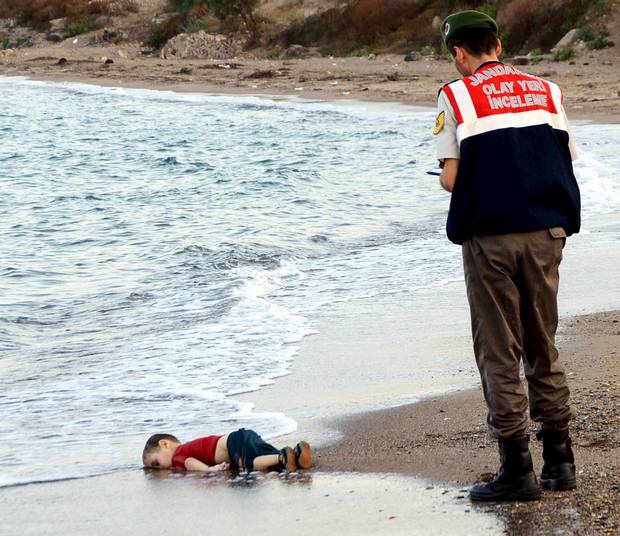
syrian-migrant-boy-turkeyBelow are a couple of links to articles that focus on the Syrian refugee crisis and this issue, while important in its own right, offers us a lot of interesting TOK questions and insights.

  • What are the ethical guidelines of using such sad and brutal images in newspapers? Do such images fairly or unfairly affect our decision making about this crisis?
  • When is it appropriate for nations to get involved in foreign conflicts?
  • How does the use of language affect our perceptions of this conflict and these people?

“They are extraordinary images and serve as a stark reminder that, as European leaders increasingly try to prevent refugees from settling in the continent, more and more refugees are dying in their desperation to flee persecution and reach safety.”

http://www.independent.co.uk/news/world/europe/if-these-extraordinarily-powerful-images-of-a-dead-syrian-child-washed-up-on-a-beach-dont-change-europes-attitude-to-refugees-what-will-10482757.html#

How a Single Photograph May Be Changing the Way the World Thinks

https://news.vice.com/article/how-a-single-photograph-may-be-changing-the-way-the-world-thinks?hash=407eb4a3-b257-471f-8044-c889627c40fa

On whether the images should be shown

Brutal Images of Syrian Boy Drowned Off Turkey Must Be Seen, Activists Say

http://www.nytimes.com/2015/09/03/world/middleeast/brutal-images-of-syrian-boy-drowned-off-turkey-must-be-seen-activists-say.html

On the use of language in this crisis:

The difference between a migrant and refugee, in one sentence

http://www.independent.co.uk/news/world/europe/the-difference-between-a-migrant-and-refugee-in-one-sentence-10476567.html#

Migrant, Refugee or Infiltrator? How Our Language Affects Legislation

http://www.haaretz.com/opinion/.premium-1.675200

Migrant, refugee, asylum-seeker…

http://www.economist.com/blogs/prospero/2015/09/johnson-political-language

When it comes to refugees, terminology matters States have an ethical and legal obligation to keep their borders open to refugees fleeing from war.

“The use of terminology is of critical importance in shaping our perceptions, attitudes and behaviours. Calling those who flee from persecution, inhumane treatment, torture, violence and war as ‘migrants’ may have irreparable consequences on government policies and the lives of thousands of actual refugees.”

The Unwelcome Return of ‘Illegals’

Ten years ago, the political strategist Frank Luntz issued a proclamation about the language of immigration. ‘‘Always refer to people crossing the border illegally as ‘illegal immigrants’ — NOT as ‘illegals,’ ’’ Luntz instructed fellow conservatives. ‘‘Illegals’’ sounds harsh and spiky. As with ‘‘fatties’’ in high school, or ‘‘thugs,’’ it’s a way to write off a group and justify its mistreatment. Luntz says his research showed that ‘‘if you used the word ‘illegals,’ you didn’t get a chance to say anything else — Latino audiences would turn you off.’’

http://www.nytimes.com/2015/08/23/magazine/the-unwelcome-return-of-illegals.html?_r=0

MIT Scientists Discover A Universal ‘Link’ Between All Languages

“Language universals are a big deal because they shed light on heavy questions about human cognition. The most famous proponent of the idea of language universals is Noam Chomsky, who suggested a “universal grammar” that underlies all languages. Finding a property that occurs in every single language would suggest that some element of language is genetically predetermined and perhaps that there is specific brain architecture dedicated to language.”

http://arstechnica.com/science/2015/08/mit-claims-to-have-found-a-language-universal-that-ties-all-languages-together/

How ‘Privilege’ Became a Provocation

But the shine has come off this hardy, once-­helpful word. It looks a little worn, a bit blunted, as if it has been taken to too many fights. Instead of clarity, it has sown confusion: ‘‘I’m white, my husband is Latino,’’ one woman commented on a blog post about confronting your privilege. ‘‘We have a Latino last name. Does that mean I lose some of my white privilege?’’ Even those who find it useful in certain contexts say the word swallows too many subtleties and individual variations. ‘‘You need to know that I was privileged,’’ Ta-­Nehisi Coates wrote on his blog for The Atlantic. ‘‘I can run you all kinds of stats on the racial wealth gap and will gladly discuss its origins. But you can’t really buy two parents like I had.’’ My own allegiance to the word is atavistic — growing up, it was one of the few words I had to understand the racism I felt so surrounded and mystified by. But now I find myself wielding the word warily, like the devalued currency it has become — dismissed as jargon or used to hector. The only reliable effect it seems to produce is panic.

http://mobile.nytimes.com/2015/07/19/magazine/how-privilege-became-a-provocation.html

How labels like ‘black’ and ‘working class’ shape your identity

“In contrast, the terms “black” and “working class” are laden with the baggage of associations, perhaps some of them positive, but many of them negative. When a person is labeled “black,” we’re primed to perceive the characteristics that we tend to associate with “blackness” more generally, which is why students drew racially ambiguous faces with typically black features when they were told the face belonged to a “black” person. Participants in the experiment at Princeton similarly associated Hannah’s working-class background with diminished intellect, so they tended to emphasize her failings and overlook her strengths when they watched her complete an academic test.”

http://theweek.com/articles/464854/how-labels-like-black-working-class-shape-identity

Study: White people see “black” Americans as less competent than “African Americans”

“The research, published in January in the Journal of Experimental Social Psychology, found that white people characterize a ‘black’ person as belonging to a lower socioeconomic status, being less competent, and having a less inviting personality than an ‘African-American’ person. And this difference in perception could have an impact on African Americans in various settings, from the labor market to the criminal justice system.”

http://www.vox.com/2015/1/2/7480843/study-african-american-black

Sorry, Pluto: You’re really not a planet

What does this article tell us about the roles of definitions and language in the natural sciences?

“What finally led the International Astronomical Union to reconsider Pluto’s status was Brown’s discovery of another Kuiper belt object, Eris, that was actually a bit more massive than Pluto. Aware that this would probably just be the first of many, the IAU voted to approve a new definition that would eliminate all of these objects from the list of planets — rather than continue to add more and more planets in future years.”

http://www.vox.com/2015/4/16/8420813/pluto-not-a-planet

Oliver Sacks on Language, Interpretation and Mishearing

“But speech must be decoded by other systems in the brain as well, including systems for semantic memory and syntax. Speech is open, inventive, improvised; it is rich in ambiguity and meaning. There is a huge freedom in this, making spoken language almost infinitely flexible and adaptable — but also vulnerable to mishearing.”

https://www.nytimes.com/2015/06/07/opinion/oliver-sacks-mishearings.html?_r=0

When You ‘Literally Can’t Even’ Understand Your Teenager

“Adolescent slang has evolved a clever defense mechanism against the threat of the search engine. Teenagers have always used words to obscure their most sensitive subjects: He’s a total babe, but he sweats this ditz who gets blazed every day after school. Now the most creative linguistic innovations elide the discussion topic entirely. ‘I can’t even’ is a confession interrupted. A close relative of ‘I can’t even’ is the keysmash, a string of actual gibberish — asdf;lkl, maybe — meant to signal that the typist has become so excited that she has lost control of her fingers. Or consider ‘Your fave could never,’ a gleeful taunt meaning roughly ‘Your favorite [actor] could never [pull off the beach ensemble modeled by my favorite actor, Darren Criss, over which I am literally dying right now].’ A reader can only decipher its meaning if she has been briefed on the speaker’s celebrity allegiances and is plugged into the web’s breakneck gossip cycle. The modern revelation doubles as a warning: Reveal less.”

http://mobile.nytimes.com/2015/06/14/magazine/when-you-literally-cant-even-understand-your-teenager.html