How America Lost Faith in Expertise And Why That’s a Giant Problem

It’s not just that people don’t know a lot about science or politics or geography. They don’t, but that’s an old problem. The bigger concern today is that Americans have reached a point where ignorance—at least regarding what is generally considered established knowledge in public policy—is seen as an actual virtue. To reject the advice of experts is to assert autonomy, a way for Americans to demonstrate their independence from nefarious elites—and insulate their increasingly fragile egos from ever being told they’re wrong…

I fear we are moving beyond a natural skepticism regarding expert claims to the death of the ideal of expertise itself: a Google-fueled, Wikipedia-based, blog-sodden collapse of any division between professionals and laypeople, teachers and students, knowers and wonderers—in other words, between those with achievement in an area and those with none. By the death of expertise, I do not mean the death of actual expert abilities, the knowledge of specific things that sets some people apart from others in various areas. There will always be doctors and lawyers and engineers and other specialists. And most sane people go straight to them if they break a bone or get arrested or need to build a bridge. But that represents a kind of reliance on experts as technicians, the use of established knowledge as an off-the-shelf convenience as desired. “Stitch this cut in my leg, but don’t lecture me about my diet.”

https://www.foreignaffairs.com/articles/united-states/2017-02-13/how-america-lost-faith-expertise
Of course technology perpetuates racism. It was designed that way.

We often call on technology to help solve problems. But when society defines, frames, and represents people of color as “the problem,” those solutions often do more harm than good. We’ve designed facial recognition technologies that target criminal suspects on the basis of skin color. We’ve trained automated risk profiling systems that disproportionately identify Latinx people as illegal immigrants. We’ve devised credit scoring algorithms that disproportionately identify black people as risks and prevent them from buying homes, getting loans, or finding jobs.

https://www.technologyreview.com/2020/06/03/1002589/technology-perpetuates-racism-by-design-simulmatics-charlton-mcilwain/

It Takes a World to End a Pandemic

Great article for discussing the production of scientific knowledge, shared knowledge, and also the new knowledge and technology theme.

Scientific Cooperation Knows No Boundaries—Fortunately

Infectious diseases, it is commonly said, know no borders, and neither does the knowledge needed to fight them. Scientists around the world routinely share information and collaborate across borders.  The current pandemic has scientists working together on platforms such as Slack, and using new tools, such as machine learning, to rapidly detect the novel coronavirus in tests that use large amounts data from multiple sources. This outbreak has demonstrated in real time how scientific understanding can indeed be a global public good.

https://www.foreignaffairs.com/articles/2020-03-21/it-takes-world-end-pandemic

How technology is designed to bring out the worst in us

“Technology feels disempowering because we haven’t built it around an honest view of human nature,” says tech critic Tristan Harris.

https://www.vox.com/technology/2018/2/19/17020310/tristan-harris-facebook-twitter-humane-tech-time

What is “brain hacking”? Tech insiders on why you should care

Anderson Cooper: Is Silicon Valley programming apps or are they programming people?

Tristan Harris: Inadvertently, whether they want to or not, they are shaping the thoughts and feelings and actions of people. They are programming people. There’s always this narrative that technology’s neutral. And it’s up to us to choose how we use it. This is just not true.

https://www.cbsnews.com/news/brain-hacking-tech-insiders-60-minutes/

Wikipedia Is the Last Best Place on the Internet

People used to think the crowdsourced encyclopedia represented all that was wrong with the web. Now it’s a beacon of so much that’s right.

By the time the internet came into being, a limitless encyclopedia was not just a natural idea but an obvious one. Yet there was still a sense—even among the pioneers of the web—that, although the substrate was new, the top-down, expert-driven Britannica model should remain in place.

https://www.wired.com/story/wikipedia-online-encyclopedia-best-place-internet/?fbclid=IwAR2Mhnm3seT9FNW3CfrAYmvPO2vo5sLueZ66ieHHyG4A2SdaQ-ql8GdLQeQ

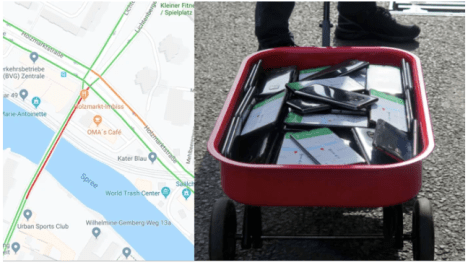
This Man Created Traffic Jams on Google Maps Using a Red Wagon Full of Phones

Screen Shot 2020-02-05 at 9.25.35 AM

The maps are their own territory, their own objective reality, not just a reflection of the real world but a branch of it. Weckert was showing us all how data and maps can affect the world they’re meant to chart. “Maps have the potential as an instrument of power,” he said. “They substitute political and military power in a way that represents the state borders between territories and they can repeat, legitimate, and construct the differences of classes and social self-understandings.”

https://www.vice.com/en_us/article/9393w7/this-man-created-traffic-jams-on-google-maps-using-a-red-wagon-full-of-phones

An algorithm that can spot cause and effect could supercharge medical AI

How do we make better use of this piecemeal information? Computers are great at spotting patterns—but that’s just correlation. In the last few years, computer scientists have invented a handful of algorithms that can identify causal relations within single data sets. But focusing on single data sets is like looking through keyholes. What’s needed is a way to take in the whole view. 

https://www.technologyreview.com/s/615141/an-algorithm-that-can-spot-cause-and-effect-could-supercharge-medical-ai/?utm_source=newsletters

Panicking About Your Kids’ Phones? New Research Says Don’t

A topic rich for TOK discuss. Seemingly all people have an opinion on the impact of smart phones on society so this topic pits intuition and personal experience against scientific investigation. This is one of the top comments that accompanies the article

I don’t care what the “academics” say. My experience as a teacher in the trenches tells a different story. One of the top reasons I retired early was cellphone addiction. All of the teachers on our campus was losing their minds because of them. My students turned into zombies. Between social media, video games, and porn, they showed zero interest in learning anything . Also, explain to me, after almost 30 years of teaching, I lost six senior girls in my last two years. Four of them my last year. All of the girls dropped out because of anxiety/depression. I have never seen anything like it in my career.

This raises article also raises questions about how we produce knowledge in the natural sciences, the role of an individual study, what high quality science is, the concept of a meta analysis, and questions about correlation vs. causation as well.

Ms. Twenge’s critics argue that her work found a correlation between the appearance of smartphones and a real rise in reports of mental health issues, but that it did not establish that phones were the cause.

It could, researchers argue, just as easily be that the rise in depression led teenagers to excessive phone use at a time when there were many other potential explanations for depression and anxiety. What’s more, anxiety and suicide rates appear not to have risen in large parts of Europe, where phones have also become more prevalent.

“Why else might American kids be anxious other than telephones?” Mr. Hancock said. “How about climate change? How about income inequality? How about more student debt? There are so many big giant structural issues that have a huge impact on us but are invisible and that we aren’t looking at.”

Here is a good short version of the same topic.

https://www.technologyreview.com/f/615071/your-kids-phone-probably-isnt-making-them-depressed/