Human cycles: History as science Advocates of ‘cliodynamics’ say that they can use scientific methods to illuminate the past. But historians are not so sure.

“What is new about cliodynamics isn’t the search for patterns, Turchin explains. Historians have done valuable work correlating phenomena such as political instability with political, economic and demographic variables. What is different is the scale — Turchin and his colleagues are systematically collecting historical data that span centuries or even millennia — and the mathematical analysis of how the variables interact.”

http://www.nature.com/news/human-cycles-history-as-science-1.11078
Poland plans to punish use of the phrase ‘Polish death camps’

“Poland has long sought to eliminate the misleading phrase from historical and newspaper accounts since it suggests the country, which was occupied by Nazi Germany during the second world war, was responsible for concentration camps on its territory.”

http://www.theguardian.com/world/2016/feb/13/poland-plans-ban-phrase-polish-death-camps?CMP=twt_gu

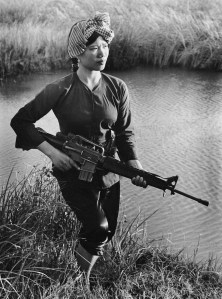
1965-1975 Another Vietnam Unseen images of the war from the winning side

NGS3475 161A
NGS3475 161A

How do these images illustrate the role that perspective plays when it comes to knowledge? When it comes to learning about History?

“For much of the world, the visual history of the Vietnam War has been defined by a handful of iconic photographs: Eddie Adams’ image of a Viet Cong fighter being executed, Nick Ut’s picture of nine-year-old Kim Phúc fleeing a napalm strike, Malcolm Browne’s photo of Thích Quang Duc self-immolating in a Saigon intersection.

“Many famous images of the war were taken by Western photographers and news agencies, working alongside American or South Vietnamese troops.

“But the North Vietnamese and Viet Cong had hundreds of photographers of their own, who documented every facet of the war under the most dangerous conditions.”

http://mashable.com/2016/02/05/another-vietnam-photography/#.vGRaZ2NPkqi

America’s First Slavery Museum Shifts the Focus from Masters to Slaves

What roles does perspective play in learning history? How might we think of the institution of slavery differently if we focused on the experiences of those who were enslaved rather than the experiences of their masters?

“The entire museum is similar: You walk the same pathways that victims of chattel slavery walked, you listen to their stories in their own words, you see and hear the pieces of history that aren’t printed in textbooks or told on other plantation tours. You won’t find much information on the wealthy slaveowners on this plantation. Instead, Whitney presents slavery through the stories of those who experienced it.”

http://www.vice.com/read/americas-first-slavery-museum-shifts-the-focus-from-masters-to-slaves-511?utm_source=vicetwitterus

The war against humanities at Britain’s universities

What makes a subject worth learning? Worth teaching? Must there be a profitable end point for those learning? Can subjects have intrinsic value? These are some of the questions surrounding issues around subjects in the Humanities (History, Social Sciences, Human Sciences, etc.).

“The liberal education which seeks to provide students with more than mere professional qualifications appears to be dying a slow and painful death, overseen by a whole cadre of what cultural anthropologist David Graeber calls “bullshit jobs”: bureaucrats hired to manage the transformation of universities from centres of learning to profit centres. As one academic put it to me: “Every dean needs his vice-dean and sub-dean and each of them needs a management team, secretaries, admin staff; all of them only there to make it harder for us to teach, to research, to carry out the most basic functions of our jobs.” The humanities, whose products are necessarily less tangible and effable than their science and engineering peers (and less readily yoked to the needs of the corporate world) have been an easy target for this sprawling new management class.”

http://www.theguardian.com/education/2015/mar/29/war-against-humanities-at-britains-universities

History Class and the Fictions About Race in America

If nothing else, the incident may serve as yet another example of why social studies—and history in particular—is such a tricky subject to teach, at least via textbooks and multiple-choice tests. Its topics are inherently subjective, impossible to distill into paragraphs jammed with facts and figures alone. As the historian and sociologist Jim Loewen recently told me, in history class students typically “have to memorize what we might call ‘twigs.’ We’re not teaching the forest—we’re not even teaching the trees,” said Loewen, best known for his 1995 book Lies My Teacher Told Me: Everything Your American History Textbook Got Wrong. “We are teaching twig history.”

http://www.theatlantic.com/education/archive/2015/10/the-history-class-dilemma/411601/?mc_cid=bed065a83a&mc_eid=34e2887073

Rethinking History Class on Columbus Day: The importance of exposing students to the many truths about the controversial explorer

“The moment was one of realization and appreciation as his daughter explained in her child-like way what Ryan conveys to his high school students: Interpreting history is hard. He then posed his final question that’s the source of heated and tense debates every year.

“Do you think we should celebrate Columbus Day in our country?”

And with a simple innocence yet profound insight that belies her age, the first-grader answered, “Yes, but we should tell the truth.  Not everyone liked Columbus.””

http://www.theatlantic.com/education/archive/2015/10/columbus-day-school-holiday/409984/?mc_cid=bed065a83a&mc_eid=34e2887073

South Korea to replace all school history books with single state-approved textbook

“Opposition politicians and some students have already been protesting against the move, accusing the government of ‘distorting history'”

“I think also the UK have a very interesting approach. We tend to avoid controversial history in our curriculum, we’re very keen on looking at more distant history and somehow, for some reason the less controversial it becomes.”

http://www.abc.net.au/news/2015-10-13/south-korea-to-replace-all-school-history-books/6849970?mc_cid=bed065a83a&mc_eid=34e2887073

A Hawaiian Canoe Crosses the Oceans, Guided by Sun and Stars

An interesting undertaking but also an interesting debate over who settled the Polynesian islands and how. What I also find interesting is why does it matter what the truth is? Why validate and continue to pursue this knowledge system? What value does it bring to continue to use traditional methods rather than use modern ones? Why keep this method alive?

“In a nod to their seafaring ancestors, the crew of 13 will forgo modern navigational equipment — no compass, sextant or GPS devices, not even an iPhone — in favor of wayfinding, a traditional navigational technique that relies on gauging the position of the sun, moon and stars, taking into account variations in ocean currents and wave patterns and even the behavior of fish and birds.”

How Texas Teaches History

An interesting article on a familiar topic but this article delves into the use of language to obfuscate historical truth. Below is a passage from the article about some of the phrasing from a textbook commonly used in Texas.

Families were often broken apart when a family member was sold to another owner.

“Note the use of the passive voice in the verbs ‘were broken apart’ and ‘was sold.’ If the sentence had been written according to the principles of good draftsmanship, it would have looked like this: Slave owners often broke slave families apart by selling a family member to another owner. A bit more powerful, no? Through grammatical manipulation, the textbook authors obscure the role of slave owners in the institution of slavery.”

http://www.nytimes.com/2015/10/22/opinion/how-texas-teaches-history.html?_r=0