THE DAILY DISH 2009: A CATALOG OF 365 PETRI DISHES PAINTED BY KLARI REIS
March 10, 2015
‘I am a mathematician, and I would like to stand on your roof.’ That is how Ron Eglash greeted many African families he met while researching the fractal patterns he’d noticed in villages across the continent.”
 “Traditionally most sand mandalas are deconstructed shortly after their completion. This is done as a metaphor of the impermanence of life. The sands are swept up and placed in an urn; to fulfill the function of healing, half is distributed to the audience at the closing ceremony, while the remainder is carried to a nearby body of water, where it is deposited. The waters then carry the healing blessing to the ocean, and from there it spreads throughout the world for planetary healing.”
http://www.mysticalartsoftibet.org/Mandala.htm
http://www.huffingtonpost.com/2014/10/07/mandala-of-compassion_n_5942202.html
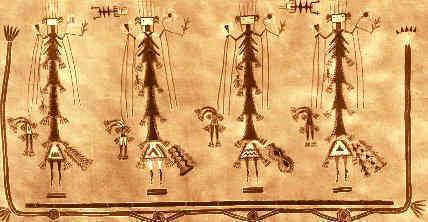
“Navajo Sandpaintings, also called dry paintings, are called “places where the gods come and go” in the Navajo language. They are used in curing ceremonies in which the gods’ help is requested for harvests and healing.
The figures in sand paintings are symbolic representations of a story in Navajo mythology. They depict objects like the sacred mountains where the gods live, or legendary visions, or they illustrate dances or chants performed in rituals.”
http://navajopeople.org/navajo-sand-painting.htm
http://www.warpaths2peacepipes.com/native-indian-art/sand-painting.htm
“Great art is always ambiguous. Rather than giving us answers, it forces us to ask new questions; complexity is its hallmark. None of this applies to American Sniper, a truly abhorrent film that cannot be confused with art, much less great art.”
https://www.jacobinmag.com/2015/02/american-sniper-war-violence-oscars/
This article is about a new state of the art storage facility that will store and facilitate the market for artwork. This story raises some interesting questions about artwork.
What determines the monetary value of artwork? Does the treatment of art as a commodity to be bought and sold and speculated upon undermine its purpose? Should great artwork be in private hands away from public view?
“The complex will be packed with thousands of works of art, from old masters to contemporary rising stars. But unlike at a museum, few will ever see the works that live inside it…
“Largely hidden from public view, an ecosystem of service providers has blossomed as Wall Street-style investors and other new buyers have entered the market. These service companies, profiting on the heavy volume of deals while helping more deals take place, include not only art handlers and advisers but also tech start-ups like ArtRank. A sort of Jim Cramer for the fine arts, ArtRank uses an algorithm to place emerging artists into buckets including ‘buy now,’ ‘sell now’ and liquidate.’ Carlos Rivera, co-founder and public face of the company, says that the algorithm, which uses online trends as well as an old-fashioned network of about 40 art professionals around the world, was designed by a financial engineer who still works at a hedge fund.”
From wikipedia: “The Death of the Author (French: La mort de l’auteur) is a 1967 essay by the French literary critic and theorist Roland Barthes. Barthes’s essay argues against traditional literary criticism’s practice of incorporating the intentions and biographical context of an author in an interpretation of a text, and instead argues that writing and creator are unrelated. ”
From the text: “Once the Author is gone, the claim to “decipher” a text becomes quite useless. To give an Author to a text is to impose upon that text a stop clause, to furnish it with a final signification, to close the writing. This conception perfectly suits criticism, which can then take as its major task the discovery of the Author (or his hypostases: society, history, the psyche, freedom) beneath the work: once the Author is discovered, the text is “explained:’”
http://www.tbook.constantvzw.org/wp-content/death_authorbarthes.pdf
Should an artist’s personal views affect how you interact with his artwork? What if those views you object to are not present in the work itself? In this particular case, Orson Scott Card, author of Ender’s Game (a personal favorite), had his book turned into a movie and many people who object to his political views are suggesting you boycott the movie to protest the author’s political views. Three articles linked below about the issue.
http://www.huffingtonpost.com/emma-rubysachs/call-off-the-enders-game_b_4140087.html
Much to the surprise of the art world, Moses found that “the more expensive the purchase price, the lower the returns.” In other words, those old masterpieces that sell for astronomical sums are not very good investments.
While it would be sacrilege in art circles to question the value of old masters like Peter Paul Rubens and Gustave Courbet, Moses points out that from a purely profit-making perspective, they are “big name underachievers.”
https://www.npr.org/sections/money/2012/05/31/153914132/is-art-a-good-investment
“Why a dead shark costs $12 million, and a photo of steel wool that looks like a tornado costs $1,265.
In other words, we wade into the economics of the art world.”
Who decides how much art is worth?
http://www.npr.org/blogs/money/2013/10/09/230950901/episode-189-why-a-dead-shark-costs-12-million

 TOK Topics