Here’s Why You Should Stop Saying ‘I Could Do That’ About Art As in, “Hey, what’s with that piece of conceptual art. I don’t get it. Like, I could do that.”

“So you look at a work of art and think to yourself, I could have done that. And maybe you really could have, but the issue here is more complex than that — why didn’t you? Why did the artist? And why does it have an audience? We delve into it by looking at work by artists like Felix Gonzalez-Torres, Piet Mondrian, and Cy Twombly, among others. You might find it’s not quite as simple as you think.”

http://www.huffingtonpost.com/entry/heres-why-you-should-stop-saying-i-could-do-that-about-art_55e9a2d2e4b002d5c075b9c6

“Green uses the work of artist Piet Mondrian as an example. She prompts you to really contemplate creating the smooth, balanced, crisp lines of his De Stijl paintings. Could you map out the framework of “Composition II in Red, Blue, and Yellow,” mix the paint colors, and painstakingly apply the oil on canvas? Could you then hand over the artwork to a gallerist, curator or buyer, and await the criticism that will inevitably come your way? Could you defend and explain your decisions to writers and curious observers, maybe even ponder the idea of questioning your own motives and engaging in real conversations about what it means to express yourself, your ideas or the ideas and perspectives of others in creative ways?”
Does the Golden Ratio Not Measure Up?

“The professor has also conducted numerous experiments in Stanford’s psychology department wherein he asks students to pick out which rectangle they like best out of a diverse group. He said the ones they select are always random and frequently change. If the golden rectangle were really the most pleasing, wouldn’t students choose it every time?”

http://hyperallergic.com/211921/does-the-golden-ratio-not-measure-up/

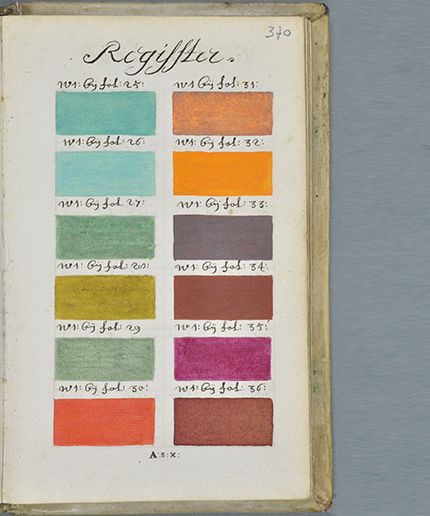
Before Pantone Color Chips, There Was This 300-Year-Old Book

image

Not quite how I would use this for TOK but it’s really really cool.

“This one-of-a-kind book was created to demonstrate how watercolors could be manipulated to change shade when different measurements of water were added to the mixture. The concept of mixing one’s own colors as a primer on color theory will surely be familiar to any first-semester art student, but Boogert’s example is notable for its thoroughness — he filled approximately 800 pages with every example imaginable.”

http://www.refinery29.com/original-pantone-color-book

6 Books Everyone (Including Your English Teacher) Got Wrong

This list and accompanying words raise some interesting questions about artistic interpretation. Does an artist have exclusive domain over the “correct” interpretation of his art work? If Fahrenheit 451 is commonly interpreted as a book about censorship and its author, Ray Bradbury, says its a book about the dangers of television, does that mean that everyone who disagrees with him is wrong? Once the artwork is created, what relationship does the artist have to it? The assumption in this article is that the author’s intent matters even if people interpret the work differently and that somehow disagreeing with the author’s own intention makes you wrong. Interesting read overall.

“With most every classic novel comes some outlandish interpretations. Some people have wild fringe theories about Harry Potter as an allegory for young gay love and Lord of the Rings being about WWII and the atom bomb. But some of these laughably wrong interpretations stick. In fact, you were taught some of them in school …”

http://www.cracked.com/article_18787_6-books-everyone-including-your-english-teacher-got-wrong.html?sr_source=lift_facebook&utm_source=simplereach&utm_medium=FB&utm_campaign=simplereach052015

Should Authors Shun or Cooperate With Chinese Censors?

“A report by the PEN American Center, which found some books were expurgated by Chinese censors without the authors even knowing it, called on those who want their works published in the lucrative Chinese market to be vigilant, and recommended a set of principles in dealing with publishers.

“But each author may approach the problem differently. How should Western authors and artists deal with Chinese government censorship? Accept or negotiate changes, or decline to have their work published at all?”

TED Talk: How sampling transformed music

“Sampling isn’t about ‘hijacking nostalgia wholesale,’ says Mark Ronson. It’s about inserting yourself into the narrative of a song while also pushing that story forward. In this mind-blowingly original talk, watch the DJ scramble 15 TED Talks into an audio-visual omelette, and trace the evolution of ‘La Di Da Di,’ Doug E. Fresh and Slick Rick’s 1984 hit that has been reimagined for every generation since.”

How do we define originality in art? The case of “Blurred Lines” and “Got to give it up”

Recently, a jury ruled that Robin Thicke and Pharrell were guilty of copyright infringement with the song, “Blurred Lines.” The jury ruled that the song too closely resembled Marvin Gaye’s song, “Got to give it up.”

You can have a listen for yourself with this youtube video that compares the two songs.

This verdict set off a wave of criticism about the ruling for a variety of reasons but putting aside the legal issues, this case raises some interesting questions about art. How do we define originality in art? How do we define copying? At what point has an artist crossed an ethical line? Or in this case, blurred the line between originality and copying? Does the fear of legal action stifle artists’ creativity?

Here’s an article that ties the changing sound of hip hop to the increasing cost of sampling beats and the increased fear of lawsuit.

Here are a couple of links to articles about the recent controversy.

1. What’s Wrong With the ‘Blurred Lines’ Copyright Ruling

“In the current context, this imitation is a more meaningful sort of infringement than what’s at play in the “Blurred Lines” case, but contemporary copyright law would seem to have less to offer a creator like DJ Mustard, whose bailiwick is everything but the notes. Like him, whole generations of songwriters may remain vulnerable, their innovations implicitly less valuable because no one’s figured out how to adequately write them down.”

http://www.nytimes.com/2015/03/12/arts/music/whats-wrong-with-the-blurred-lines-copyright-ruling.html

2.Why the “Blurred Lines” Copyright Verdict Should Be Thrown Out

“There is no question that Pharrell was inspired by Gaye and borrowed from him; he has freely admitted as much. But, by that standard, every composer would be a lawbreaker. The question is not whether Pharrell borrowed from Gaye but whether Gaye owned the thing that was borrowed. And this is where the case falls apart. For it was not any actual sequence of notes that Pharrell borrowed, but rather the general style of Gaye’s songs. That is why ‘Blurred Lines’ sounds very much like a Marvin Gaye song. But to say that something ‘sounds like’ something else does not amount to copyright infringement.”

http://www.newyorker.com/culture/culture-desk/why-the-blurred-lines-copyright-verdict-should-be-thrown-out

Review: ‘The Plains Indians,’ America’s Early Artists, at the Met

20150313PLAINS-slide-0Q4A-articleLarge

“Painted robes, covered with figures and symbols and accessorized with leggings and gloves, became storyboards of oral history and epic adventure. One monumental example from the Branly collection, fittingly known as the Grand Robe, depicts, in more than a dozen episodes and with a cast of some 60 figures, the Homeric exploits of two Lakota warriors. There are debates over the gender of the artists of certain robes. But in general, paintings and drawings were done by men, and tanning, sewing and beadwork by women. And outstanding examples of beadwork, positioned throughout the show, glow with a kind of self-generated light.”