As British scientists seek to edit the genes of embryos; bioethicists warn of potential dangers

“It was the first time edits had been confirmed to have been done on reproductive cells and the news caused deep divisions within the scientific community. Some expressed optimism and hope that such research could eventually lead to the eradication of genetic diseases from the face of the Earth. Others were horrified — warning that genetically modifying humans is unsafe and could have devastating consequences on future generations of our race that no one can foresee.”

http://www.washingtonpost.com/rweb/api/print.html?id=4c92e97901b450352df9f3f89c5f4496

Radiolab Podcast: The Rhino Hunter

How do we judge the morality of hunting? Is it ever ethical to kill an animal? What if the hunt raises money for conservation efforts? What if the animal being killed was a threat to younger members of the herd? Below is a podcast that interviews the famous/infamous hunter who was cast into international spotlight for his buying a permit to hunt a black rhino which is an endangered species. People had very angry and visceral reactions to hearing about this. The issue is much deeper than simple reactive anger and offers us a great issue with which to examine ethics. Below are links to some articles on the topic that I have previous posted.

“Back in 2014, Corey Knowlton paid $350,000 for a hunting trip to Namibia to shoot and kill an endangered species.  He’s a professional hunter, who guides hunts all around the world, so going to Africa would be nothing new.  The target on the other hand would be. And so too, he quickly found, would be the attention.

“This episode, producer Simon Adler follows Corey as he dodges death threats and prepares to pull the trigger.  Along the way we stop to talk with Namibian hunters and government officials, American activists, and someone who’s been here before – Kenya’s former Director of Wildlife, Richard Leakey.   All the while, we try to uncover what conservation really means in the 21st century.”

http://www.radiolab.org/story/rhino-hunter/

“A US hunter who paid $350,000 to kill a black rhinoceros in Namibia successfully shot the animal on Monday, saying that his actions would help protect the critically-endangered species.”

http://news.yahoo.com/texas-hunter-shoots-endangered-namibian-rhino-350-000-000807061.html

Here is an article arguing in favor of that policy.

http://www.ozy.com/immodest-proposal/save-the-animals-by-hunting-them/39349?utm_source=dd&utm_medium=email&utm_campaign=05202015

When Continental Drift Was Considered Pseudoscience

“We like to imagine that knowledge advances fact upon dispassionate fact to reveal precise and irrefutable truths. But there is hardly a better example of just how messy and emotional science can be than Wegener’s discovery of the vast, turbulent forces moving within the earth’s crust. As often happens when confronted with difficult new ideas, the establishment joined ranks and tore holes in his theories, mocked his evidence and maligned his character. It might have been the end of a lesser man, but as with the vicious battles over topics ranging from Darwinian evolution to climate change, the conflict ultimately worked to the benefit of scientific truth.”

http://www.smithsonianmag.com/science-nature/when-continental-drift-was-considered-pseudoscience-90353214/

One woman’s mission to photograph every Native American tribe in the US

What does this article tell us about the power of culture and imagery in shaping our perceptions of various groups of people? To what degree can those perceptions be changed? Is it wrong to propagate false or inaccurate representations? This connects to the debate about sports mascots to some degree.

“Matika Wilbur has traveled more than 250,000 miles to ensure stereotyped images are replaced with accurate ones to change history’s collective psyche.”

“A search for Native Americans on the internet yields almost nothing but reductionist, 18th-century representations of a ‘feathered and leathered people’, Wilbur says. She hopes the pictures she’s taking can someday replace the stereotyped, dated ones found in internet searches, and the ones we hold on to in our collective psyche.

“‘I’m ultimately doing this because our perception matters,’ she says. ‘Our perception fuels racism. It fuels segregation. Our perception determines the way we treat each other.'”

http://www.theguardian.com/us-news/2015/sep/07/native-american-photographs-matika-wilbur-project-562?hash=105388b0-c278-4722-9bb6-2b2df05942bb

Who’s the Bad Guy? The View on Foreign Policy From Tehran

“In the Western view, an aggressive Iran seeks to create a Shia Crescent under its control, stretching from Lebanon through Syria, Iraq, and into Bahrain and Yemen.

“The US, Britain, Israel, and other Western powers point at Iran providing arms to the Lebanese group Hezbollah and Syrian President Bashar al-Assad, backing Houthi rebels in Yemen, and controlling some Shia militias in Iraq.

“Yet Iranians see their national security in exact opposite terms. They are the victims and the West supports terrorism. As a result of wars in Afghanistan and Iraq, the US has stationed troops in countries along Iran’s borders. The US backs Saudi Arabia’s aggressive actions against the Houthis in Yemen.

“According to this view, the West has laid the ground work for turning Syria into a failed state. Any arms shipments or political support offered by Iran is purely in self-defense, according to Iranian officials.”

https://news.vice.com/article/whos-the-bad-guy-the-view-on-foreign-policy-from-tehran

Rashomon on the West Bank: Israelis and Palestinians Debate Images of Soldier and Child

01open_headlock-articleLarge

“Despite broad agreement about the central facts — a spokeswoman for the Israel Defense Forces said that the soldier “attempted to detain an individual who had been identified as throwing rocks” and was foiled; the boy’s mother, who participated in the struggle to free him, said he had been throwing rocks — there is an intense debate about what, precisely, the images convey about the Israeli military occupation of this territory, which has now lasted nearly five decades.

“Supporters of the Palestinian cause say the images of an armed soldier placing a 12-year-old boy with a cast on his arm in a headlock is important evidence of what they call the brutality of life under military rule.

“Many Israelis, including some senior officials, concurred with domestic media accounts that depicted the soldier as showing great restraint as the victim of a violent attack by the female protesters.”

http://www.nytimes.com/2015/09/02/world/middleeast/rashomon-on-the-west-bank-israelis-and-palestinians-debate-images-of-soldier-and-child.html?ribbon-ad-idx=6&rref=collection/column/open-source

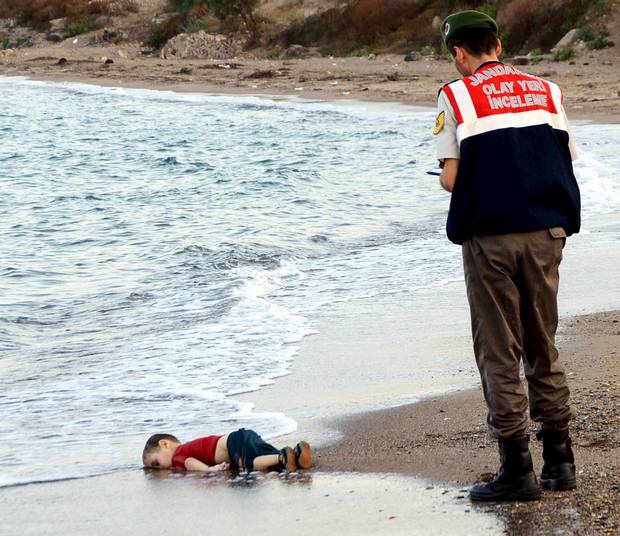
If these extraordinarily powerful images of a dead Syrian child washed up on a beach don’t change Europe’s attitude to refugees, what will?

syrian-migrant-boy-turkeyBelow are a couple of links to articles that focus on the Syrian refugee crisis and this issue, while important in its own right, offers us a lot of interesting TOK questions and insights.

  • What are the ethical guidelines of using such sad and brutal images in newspapers? Do such images fairly or unfairly affect our decision making about this crisis?
  • When is it appropriate for nations to get involved in foreign conflicts?
  • How does the use of language affect our perceptions of this conflict and these people?

“They are extraordinary images and serve as a stark reminder that, as European leaders increasingly try to prevent refugees from settling in the continent, more and more refugees are dying in their desperation to flee persecution and reach safety.”

http://www.independent.co.uk/news/world/europe/if-these-extraordinarily-powerful-images-of-a-dead-syrian-child-washed-up-on-a-beach-dont-change-europes-attitude-to-refugees-what-will-10482757.html#

How a Single Photograph May Be Changing the Way the World Thinks

https://news.vice.com/article/how-a-single-photograph-may-be-changing-the-way-the-world-thinks?hash=407eb4a3-b257-471f-8044-c889627c40fa

On whether the images should be shown

Brutal Images of Syrian Boy Drowned Off Turkey Must Be Seen, Activists Say

http://www.nytimes.com/2015/09/03/world/middleeast/brutal-images-of-syrian-boy-drowned-off-turkey-must-be-seen-activists-say.html

On the use of language in this crisis:

The difference between a migrant and refugee, in one sentence

http://www.independent.co.uk/news/world/europe/the-difference-between-a-migrant-and-refugee-in-one-sentence-10476567.html#

Migrant, Refugee or Infiltrator? How Our Language Affects Legislation

http://www.haaretz.com/opinion/.premium-1.675200

Migrant, refugee, asylum-seeker…

http://www.economist.com/blogs/prospero/2015/09/johnson-political-language

Are Hunters more Moral than Vegans?

“Essentially, the basis of Davis’ argument is, what gives anyone the moral right to say that the small rodents killed from crop harvest is less valuable than that of the cow (or deer in this case)? Although the debate still ensues on how many insects, rodents, birds and small mammals become causalities of the harvest, it is undisputed that it actually happens.”

http://huntergreen.org/green-living/are-hunters-more-moral-than-vegans/#.Vcp3mf1lxAA.facebook

When it comes to refugees, terminology matters States have an ethical and legal obligation to keep their borders open to refugees fleeing from war.

“The use of terminology is of critical importance in shaping our perceptions, attitudes and behaviours. Calling those who flee from persecution, inhumane treatment, torture, violence and war as ‘migrants’ may have irreparable consequences on government policies and the lives of thousands of actual refugees.”

Here’s Why You Should Stop Saying ‘I Could Do That’ About Art As in, “Hey, what’s with that piece of conceptual art. I don’t get it. Like, I could do that.”

“So you look at a work of art and think to yourself, I could have done that. And maybe you really could have, but the issue here is more complex than that — why didn’t you? Why did the artist? And why does it have an audience? We delve into it by looking at work by artists like Felix Gonzalez-Torres, Piet Mondrian, and Cy Twombly, among others. You might find it’s not quite as simple as you think.”

http://www.huffingtonpost.com/entry/heres-why-you-should-stop-saying-i-could-do-that-about-art_55e9a2d2e4b002d5c075b9c6

“Green uses the work of artist Piet Mondrian as an example. She prompts you to really contemplate creating the smooth, balanced, crisp lines of his De Stijl paintings. Could you map out the framework of “Composition II in Red, Blue, and Yellow,” mix the paint colors, and painstakingly apply the oil on canvas? Could you then hand over the artwork to a gallerist, curator or buyer, and await the criticism that will inevitably come your way? Could you defend and explain your decisions to writers and curious observers, maybe even ponder the idea of questioning your own motives and engaging in real conversations about what it means to express yourself, your ideas or the ideas and perspectives of others in creative ways?”