How to Counter the Circus of Pseudoscience

“That is also the case for other health professionals whose practice is based on science, like qualified dietitians, physiotherapists, occupational therapists and psychologists. Guidelines are revised, advice is reversed — on blood pressure, diet, hormone replacement, opioid prescribing. This can be immensely frustrating for patients, even though it is what we must do to provide the best possible treatment.”

The sun may never set on British misconceptions about our empire

But then what could our teachers have said? Empire was an uncomfortable subject. By the 1950s, an approach that stressed glorious conquest and the benefits of British rule was no longer tenable, and not only for moral reasons. What had been bloodily won was now being lost, usually peacefully but sometimes not, no matter that we would all be friends in the equitable-sounding Commonwealth. National decline would have been an unhappy theme in the classroom. Rather than this awkward mixture of past and present – one that might intimately involve us – it was safer to concentrate on the sufferings of the Paris commune.

https://www.theguardian.com/commentisfree/2018/jan/06/british-misconceptions-empire-guilty-colonialism?CMP=share_btn_fb

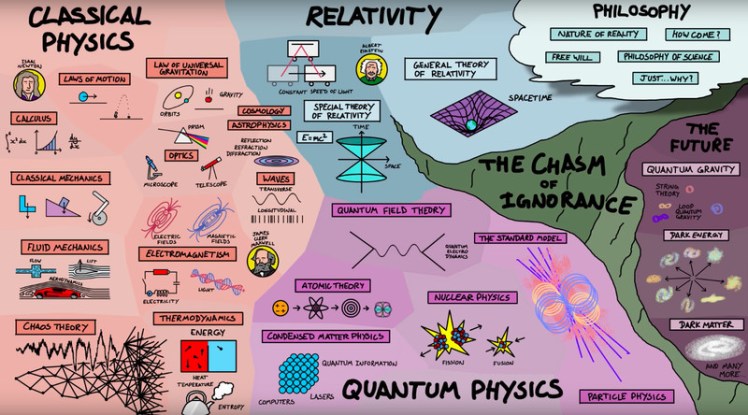
Physics has a dizzying array of subdisciplines. This short video breaks it down.

How does scientific knowledge progress? What are the implications and consequences of this progress? How does this “map” of scientific knowledge accurately represent underlying reality?

Science Fields

“As Walliman’s animation shows, there’s still a giant “chasm of ignorance” that scientists are seeking to fill. Even though scientists now know a lot about things like optics, thermodynamics, fluid mechanics, and electromagnetism, their tested theories still can’t explain things like dark matter and dark energy. And there’s no complete theory that squares quantum physics with relativity.”

https://www.vox.com/science-and-health/2016/11/29/13769152/physics-subdiscipline-video

In Canada, Hunting and Preserving an Indigenous Way of Life

“When our grandparents and parents were forced to go to residential schools and literally torn away from their families, that knowledge was lost,” he said, noting that he had spent hours badgering his elderly aunts to share their old recipes and secrets, including how to make oolichan grease, or fermented smoked fish fat, which he uses to flavor soups or sauces.

Ms. Nottaway considers cooking her best weapon against assimilation, and on a recent Thursday afternoon, she set out to hunt for deer, partridge and beaver in a snow-covered forest on the reservation.

Soon We’ll Cure Diseases With a Cell, Not a Pill | Siddhartha Mukherjee | TED Talks

How are models used in medicine? How does a faulty or limited model negatively impact our approaches to treating the human body? Really great TED talk about these questions

Current medical treatment boils down to six words: Have disease, take pill, kill something. But physician Siddhartha Mukherjee points to a future of medicine that will transform the way we heal.

P.C. Language Saved My Life

If I’d had access to the right language, it’s possible that I might have felt empowered by this change. Instead, people on campus began referring to me as “it” or “he-she.” Eventually I folded into myself. I cut my hair off, wore drastically less makeup and took to wearing all black clothing, because I was constantly mourning the identities I might have had, that the world had slowly killed. I became increasingly depressed and even attempted to end my life.

How science and First Nations oral tradition are converging

The researchers also found that roughly 175 years ago, the population of Coast Tsimshian in the region declined by as much as 57 per cent. This coincides with colonization and the spread of diseases such as smallpox, the accounts of which have also been passed down in First Nations oral tradition.

“Science is starting to be used to basically corroborate what we’ve been saying all along,” said Barbara Petzelt, an archaeologist with the Metlakatla First Nation, one of the researchers in the study.

http://www.cbc.ca/news/technology/science-first-nations-oral-tradition-converging-1.3853799

Trump Administration’s CDC Bans Certain Words

Below are a couple of articles regarding the recent news.

Words banned at multiple HHS agencies include ‘diversity’ and ‘vulnerable’

The Trump administration has informed multiple divisions within the Department of Health and Human Services that they should avoid using certain words or phrases in official documents being drafted for next year’s budget.

Officials at the Centers for Disease Control and Prevention, which is part of HHS, were given a list of seven prohibited words or phrases during a meeting Thursday with senior CDC officials who oversee the budget. The words to avoid: “vulnerable,” “entitlement,” “diversity,” “transgender,” “fetus,” “evidence-based” and “science-based.”

https://www.washingtonpost.com/national/health-science/words-banned-at-multiple-hhs-agencies-include-diversity-and-vulnerable/2017/12/16/9fa09250-e29d-11e7-8679-a9728984779c_story.html?utm_term=.46e926e6bb7e

Why Words Matter: What Cognitive Science Says about Prohibiting Certain Terms

How much does it really matter if a government agency avoids certain language in documents sent to Congress, the Office of Management and Budget and other agencies?

Perhaps a great deal. Scientific American spoke with Lera Boroditsky, a cognitive scientist at the University of California, San Diego, about the significance of this recent news, why words matter and how language changes our perceptions of the world.

https://www.scientificamerican.com/article/why-words-matter-what-cognitive-science-says-about-prohibiting-certain-terms/

Science vs. Humanities in 3 Rounds. Steven Pinker and Leon Wieseltier discuss.

Science Is Not Your Enemy: An impassioned plea to neglected novelists, embattled professors, and tenure-less historians

Though everyone endorses science when it can cure disease, monitor the environment, or bash political opponents, the intrusion of science into the territories of the humanities has been deeply resented. Just as reviled is the application of scientific reasoning to religion; many writers without a trace of a belief in God maintain that there is something unseemly about scientists weighing in on the biggest questions. In the major journals of opinion, scientific carpetbaggers are regularly accused of determinism, reductionism, essentialism, positivism, and worst of all, something called “scientism.”

https://newrepublic.com/article/114127/science-not-enemy-humanities

Crimes Against Humanities: Now science wants to invade the liberal arts. Don’t let it happen.

The question of the place of science in knowledge, and in society, and in life, is not a scientific question. Science confers no special authority, it confers no authority at all, for the attempt to answer a nonscientific question. It is not for science to say whether science belongs in morality and politics and art. Those are philosophical matters, and science is not philosophy, even if philosophy has since its beginnings been receptive to science. Nor does science confer any license to extend its categories and its methods beyond its own realms, whose contours are of course a matter of debate.

https://newrepublic.com/article/114548/leon-wieseltier-responds-steven-pinkers-scientism

Science vs. the Humanities, Round III

Wieseltier bristles at my suggestion that science is distinguished by the value it places on the thorough-going intelligibility of the world—on the relentless search beyond the explanation of a phenomenon for a still deeper explanation of the explicans. Yet he legislates that the humanities may tolerate no such curiosity.

https://newrepublic.com/article/114754/steven-pinker-leon-wieseltier-debate-science-vs-humanities