The Price of Certainty

NYTimes Op-Doc exploring the psychological basis of our need for certainty and its pitfalls. Narrated by psychologist Arie Kruglanski who coined the term “cognitive closure.”

From 2016 but still offers meaningful insight into our current moment in politics.

“People who are anxious because of the uncertainty that surrounds them are going to be attracted to messages that offer them certainty. The need for closure is the need for certainty. To have clear-cut knowledge. You feel that you need to stop processing too much information, stop listening to a variety of information and zero in on what, to you, appears to be the truth. The need for closure is absolutely essential but it can also be extremely dangerous.”

Roosevelt Statue to Be Removed From Museum of Natural History (and other related links)

Below are a few resources surrounding the recent removal/destruction of statues.

“The world does not need statues, relics of another age, that reflect neither the values of the person they intend to honor nor the values of equality and justice,” said Theodore Roosevelt IV, age 77, a great-grandson of the 26th president and a museum trustee.

From the artist, John Russell Pope, in 1928:

“In the center of the terrace…will arise a polished granite pedestal bearing an equestrian statue of Roosevelt with two accompanying figures on foot, one representing the American Indian and the other the primitive African. This heroic group…will symbolize the fearless leadership, the explorer, benefactor and educator….”—From a description of the architect’s design approved by the Memorial Commission, 1928

Commenting on the recent controversy: “Pope refers to the figures as a ‘heroic group.’ That’s important. In some criticisms, the standing figures were taken to be lesser than Roosevelt. That was never the intention. They are allegorical figures representing Africa and America, emphasized by the animals on the parapet reliefs.”—Harriet F. Senie, Director, M.A. Art History, Art Museum Studies, The City College of New York

What’s the point of statues?

To the minds of people in the eighteenth and nineteenth centuries, public art had a very clear purpose, which seems to have been forgotten in the minds of many people today. Rather than teaching history, or even celebrating the memory of a particular person, so much of the art that still dots our public places was explicitly about inculcating virtue – good morals, and good habits.

It’s a notion that sits uneasily with us now. It’s hard to think of any artist today who would be so bold as to tell us all how we should think and act.

https://fl.ink/explore/whats-the-point-of-statues

Some Statues Are Like Barbed Wire

Activists fighting to remove statues of slavers and colonizers understand better than most how public memorials can be a form of violence.

Thinking about how and why statues go up might help us to think about if they should come down. Once a statue is in place, it is easy to think of it as an eternal and inevitable presence—a view that informs the notion that removing statues is tantamount to “erasing history.” However, statues don’t happen by accident; it takes the concerted will and money of an individual or group to have a monument take form in stone or metal in a public place. Thinking through the intentions of how, where, and when a given statue came to exist in a given space at a given time offers a way past scaremongering about slippery slopes and the erasing of history to consider the story a statue tells, and if that is a story that belongs in a public place in 2020.

https://bostonreview.net/race/jonathan-beecher-field-some-statues-are-barbed-wire?utm

Foreign Affairs Magazine January/February 2018 The Undead Past

An excellent collection of articles discussing the role of history and memory and how different nations including the U.S., Russia, China, Germany, Rwanda, and South Africa have dealt with their pasts.

From the introduction to the issue:

How do nations handle the sins of the fathers and mothers? Take genocide, or slavery, or political mass murder. After such knowledge, what forgiveness—and what way forward? The Germans have a word for it, of course: Vergangenheitsbewältigung, or “coming to terms with the past.” But the concept is applicable far beyond the Nazis

https://www.foreignaffairs.com/issues/2018/97/1(may be behind a paywall)

Here are a bunch more posts about historical monuments and history.

https://toktopics.com/tag/monuments/
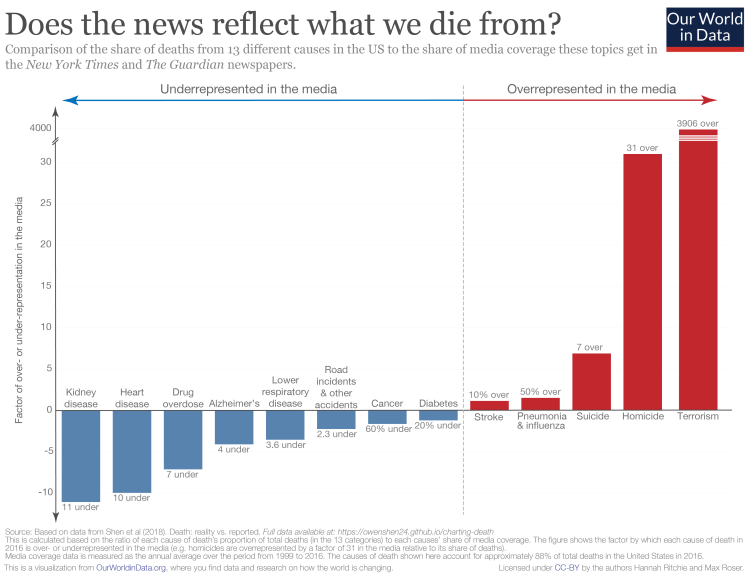


Does the news reflect what we die from?

This is a page from the excellent site, “Our World in Data” which describes its mission as:

We believe that a key reason why we fail to achieve the progress we are capable of is that we do not make enough use of this existing research and data: the important knowledge is often stored in inaccessible databases, locked away behind paywalls and buried under jargon in academic papers.

The goal of our work is to make the knowledge on the big problems accessible and understandable. As we say on our homepage, Our World in Data is about Research and data to make progress against the world’s largest problems.

This helps us evaluate how we acquire knowledge about the world and how reliable it is. Specifically, this helps us explore the contrast between emotion and reason as ways of acquiring knowledge and gives us some specific materials around the utility of math and data in learning about the world.

Among many questions they ask is whether the news reflects what we die from and why it matters. Great data and visuals along with discussions of the key issues involved.

https://ourworldindata.org/does-the-news-reflect-what-we-die-from

Over-and-underrepresentation-of-deaths-in-media

The short history of global living conditions and why it matters that we know it

From the same site an exploration of macro world trends regarding global living conditions and our misperceptions of them.

https://ourworldindata.org/a-history-of-global-living-conditions-in-5-charts

Two-centuries-World-as-100-people

Here is a simple handout I made from the relevant text from the above links along with appropriate graphs and images. I’ve added nothing  to these. Just cut and pasted what I thought was most relevant for a class. Haven’t used it yet.

Download Perception vs Truth

Related handouts:

Download Assessing Risk Handout

Here is the article that accompanies the handout above.

Download Ten Ways We Get the Odds Wrong

Some different questions that get at the same point.

Download Alternative Assessing Risk

Here is yet another interesting example from Swedish physician Hans Rosling. He came up with a simple quiz assessing people’s knowledge of human development statistics. Even development experts were woefully unaware. You can take the quiz here:

https://factfulnessquiz.com/ 

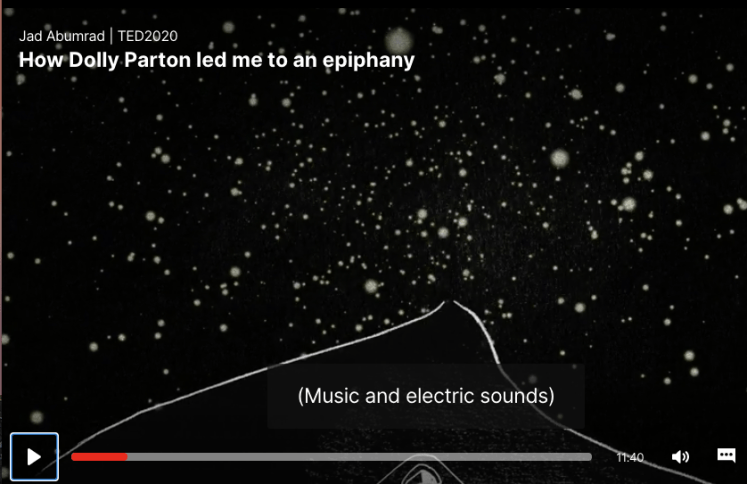
TED Talk: Jad Abumrad: “How Dolly Parton led me to an epiphany”

13 minute talk that covers some interesting ground. What is truth? How do we arrived at it? Can there be multiple “truths”?

A couple of interesting quotes from his reflections on telling stories:

“…maybe I was relying too much on science to find the truth.”

“There were a lot of truths in the room at that moment and we were only looking at one of them.

He started to do stories where “everything is disputed all you can do is struggle to make sense. And the struggle kind of became the point.”

“We live in a world where truth is no longer just a set of facts to be captured. It’s a process. It’s gone from being a noun to being a verb.”

“I committed myself to doing stories where you heard truths collide.”

How do you end a story? Host of “Radiolab” Jad Abumrad tells how his search for an answer led him home to the mountains of Tennessee, where he met an unexpected teacher: Dolly Parton.

Screen Shot 2020-06-29 at 4.02.56 PM


The Value of Art

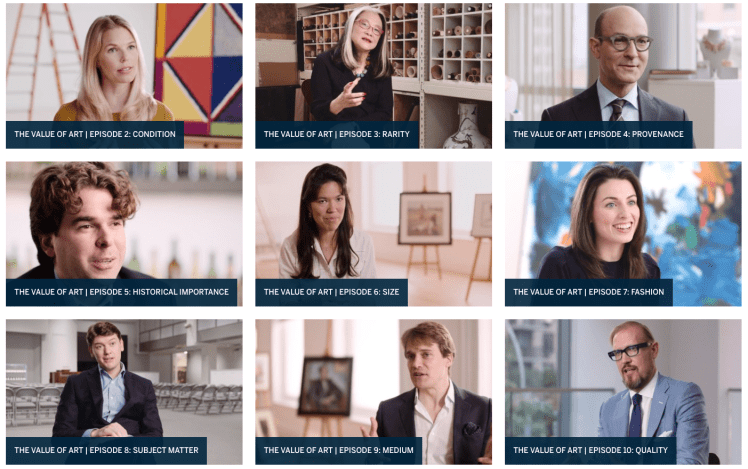
10 short videos created by Sotheby’s identifying and discussing 10 different qualities.

The Value of Art | Episode 1: Authenticity
“Authenticity is the soul of the object,” says Chinese works of art expert Nicolas Chow, adding “Anything that is worth something is worth being faked.” In Episode 1, see how Chow and other Sotheby’s specialists identify the true originals. Sometimes consulting an artist’s catalogue raisonné is enough to affirm authenticity, but other pieces require sleuthing for clues that only a seasoned expert would think to sniff out – sometimes quite literally.

Screen Shot 2020-06-06 at 5.30.03 PM

https://www.sothebys.com/en/series/the-value-of-art

Why your brain is not a computer

The metaphors of neuroscience – computers, coding, wiring diagrams and so on – are inevitably partial. That is the nature of metaphors, which have been intensely studied by philosophers of science and by scientists, as they seem to be so central to the way scientists think. But metaphors are also rich and allow insight and discovery. There will come a point when the understanding they allow will be outweighed by the limits they impose, but in the case of computational and representational metaphors of the brain, there is no agreement that such a moment has arrived. From a historical point of view, the very fact that this debate is taking place suggests that we may indeed be approaching the end of the computational metaphor. What is not clear, however, is what would replace it.

https://www.theguardian.com/science/2020/feb/27/why-your-brain-is-not-a-computer-neuroscience-neural-networks-consciousness?fbclid=IwAR2_QcpdSDnEO3i9gz0PWdxANWAbSavthTckzRZPhcBgX3sqNZFGEhIZZI4

How America Lost Faith in Expertise And Why That’s a Giant Problem

It’s not just that people don’t know a lot about science or politics or geography. They don’t, but that’s an old problem. The bigger concern today is that Americans have reached a point where ignorance—at least regarding what is generally considered established knowledge in public policy—is seen as an actual virtue. To reject the advice of experts is to assert autonomy, a way for Americans to demonstrate their independence from nefarious elites—and insulate their increasingly fragile egos from ever being told they’re wrong…

I fear we are moving beyond a natural skepticism regarding expert claims to the death of the ideal of expertise itself: a Google-fueled, Wikipedia-based, blog-sodden collapse of any division between professionals and laypeople, teachers and students, knowers and wonderers—in other words, between those with achievement in an area and those with none. By the death of expertise, I do not mean the death of actual expert abilities, the knowledge of specific things that sets some people apart from others in various areas. There will always be doctors and lawyers and engineers and other specialists. And most sane people go straight to them if they break a bone or get arrested or need to build a bridge. But that represents a kind of reliance on experts as technicians, the use of established knowledge as an off-the-shelf convenience as desired. “Stitch this cut in my leg, but don’t lecture me about my diet.”

https://www.foreignaffairs.com/articles/united-states/2017-02-13/how-america-lost-faith-expertise

Why the ‘Unreasonable Effectiveness’ of Mathematics?

What is it about #mathematics that it can describe so accurately the world around us? From quantum physics, the very smallest features and forces of the foundations of matter and energy, to cosmology, the very largest structures and forces of the beginning and evolution of the universe, mathematics is the language of description. Why does the physical world follow so faithfully equations of abstract symbols and variables?

https://youtu.be/uqGbn4b3LPM?t=144


Max Tegmark – Is Mathematics Invented or Discovered?

Mathematics describes the real world of atoms and acorns, stars and stairs, with remarkable precision. So is mathematics invented by humans just like chisels and hammers and pieces of music? Or is mathematics discovered—always out there, somewhere, like mysterious islands waiting to be found? Whatever mathematics is will help define reality itself.

https://www.youtube.com/watch?v=ybIxWQKZss8

Other great videos and interviews in this series you can find linked here on their website. Covers a wide set of topics.

https://www.closertotruth.com/about/content-guide


Hydroxychloroquine and the Political Polarization of Science

How a drug became an object lesson in political tribalism.

Why are we seeing the polarization over hydroxycholorquine, then, in spite of the serious consequences? The explanation may lie in the kind of information available to the public about COVID-19, which differs importantly from what we see in other cases of polarization about science. When it comes to the health effects of injecting disinfectants, there is no uncertainty about the massive risks. And for that reason, we don’t expect polarization to emerge, even if Trump suggests trying it. But even the best information about COVID-19 is in a state of constant flux. Scientists are publishing new articles every day, while old articles and claims are retracted or refuted. Norms of scientific publication, which usually dictate slower timeframes and more thorough peer review, have been relaxed by scientific communities desperately seeking solutions. And with readers clamoring for the latest virus news, journalists are on the hunt for new articles they can report on, sometimes pushing claims into prime time before they’ve been properly vetted.

https://bostonreview.net/science-nature-politics/cailin-oconnor-james-owen-weatherall-hydroxychloroquine-and-political

After the publication of this article, there was a retraction of a high profile study that suggested hydrochloroquine would lead to increased mortality and was ineffective as a treatment for covid-19.

All of this happened in the hyperpolarized context of American politics, referred to in the article above, in which even scientific truth bent around President Trump’s words.

https://www.npr.org/sections/coronavirus-live-updates/2020/06/04/870022834/authors-retract-hydroxychloroquine-study-citing-concern-over-data