AI has the potential to save lives but this could come at the cost of civil liberties like privacy. How do we address those trade-offs in ways that are acceptable to lots of different people? We haven’t figured out how to deal with the inevitable disagreements.
AI ethics also tends to respond to existing problems rather than anticipate new ones. Most of the issues that people are discussing today around algorithmic bias came up only when high-profile things went wrong, such as with policing and parole decisions.
This idea of a gullible, pliable populace is, of course, nothing new. Voltaire said, “those who can make you believe absurdities can make you commit atrocities”. But no, says Mercier, Voltaire had it backwards: “It is wanting to commit atrocities that makes you believe absurdities”…
If someone says Obama is a Muslim, their primary reason may be to indicate that they are a member of the group of people who co-ordinate around that statement. When a social belief and a true belief are in conflict, Klintman says, people will opt for the belief that best signals their social identity – even if it means lying to themselves…
Such a “belief” – being largely performative – rarely translates into action. It remains what Mercier calls a reflective belief, with no consequences on one’s behaviour, as opposed to an intuitive belief, which guides decisions and actions.
Whether you think we are making history or repeating it, it’s safe to say we are living in a historic time. In this episode, Why It Matters asks three historians to weigh in on how to use the past to examine the present and make better choices for the future.
Annette GORDON-REED: Things that may seem perplexing to you, have their roots in things that happened in the past. It would be as if you were trying to tell your story to someone, but you didn’t know where you were born. You didn’t know who your parents were. You didn’t have any memories of things that had happened when you were a child. History consists of, of things in the past that have had a bearing on the present that you might wanna know. That help you explain why you’re in the situation you’re in, why we are in a situation in a given society.
“We’ve arranged a global civilization in which most crucial elements profoundly depend on science and technology. We have also arranged things so that almost no one understands science and technology. This is a prescription for disaster. We might get away with it for a while, but sooner or later this combustible mixture of ignorance and power is going to blow up in our faces…
“I worry that…pseudoscience and superstition will seem year by year more tempting, the siren song of unreason more sonorous and attractive. Where have we heard it before? Whenever our ethnic or national prejudices are aroused, in times of scarcity, during challenges to national self-esteem or nerve, when we agonize about our diminished cosmic place and purpose or when fanaticism is bubbling up around us– then, habits of thought familiar from ages past reach for the controls. The candle flame gutters. Its little pool of light trembles. Darkness gathers. The demons begin to stir…
“Science is more than a body of knowledge; it is a way of thinking. I have a foreboding of an America in my children’s or grandchildren’s time — when the United States is a service and information economy; when nearly all the key manufacturing industries have slipped away to other countries; when awesome technological powers are in the hands of a very few, and no one representing the public interest can even grasp the issues; when the people have lost the ability to set their own agendas or knowledgeably question those in authority; when, clutching our crystals and nervously consulting our horoscopes, our critical faculties in decline, unable to distinguish between what feels good and whats true, we slide, almost without noticing, back into superstition and darkness. The dumbing down of America is most evident in the slow decay of substantive content in the enormously influential media, the 30-second sound bites (now down to 10 seconds or less), the lowest common denominator programming, credulous presentations on pseudoscience and superstition, but especially a kind of celebration of ignorance.”
.
Jacob Bronowski on the dangers of dogma
Relatedly, here is a clip from the 1970s television adaptation of the book, The Ascent of Man by Jacob Bronowski.
Jacob Bronowski explains why the pursuit of science is better than seeking absolute knowledge.
Seriously, this is the last time I’m posting anything about statues. The first is a thoughtful piece that compares how we think about morality in history to the progress of science. The second is a podcast that delves into the questions around why we care about monuments and statues. For previous posts about this topic, click here.
Are these long-overdue corrections in the name of social justice, or simply ideologically driven acts of anti-historical vandalism? The answer depends on how we judge the moral actions of figures from the past, a question that in turn requires us to consider the nature of morality itself…
Knowledge is a relay race. It is a fundamental misunderstanding about how it works to criticize a swift runner who effectively passed the baton because he did not complete the race on his own….
All of which to say, there is a vital difference between being wrong and being blameworthy….
When it comes to praise and blame, intention and context matter, not just a snapshot of the final result.
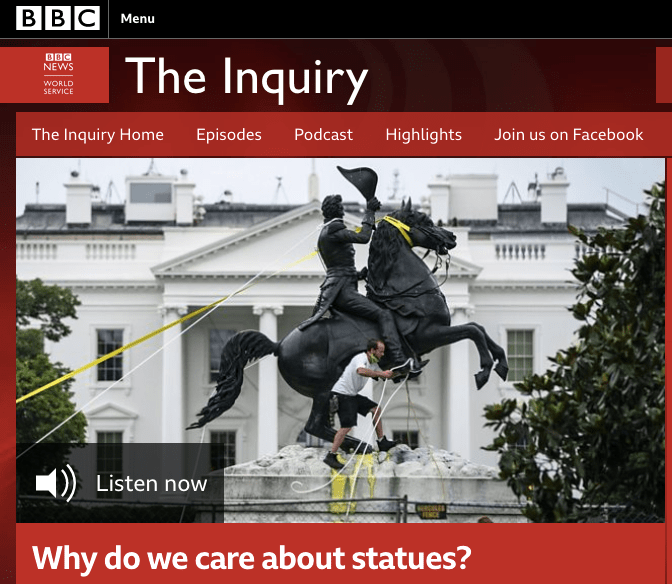
The Inquiry Podcast: Why do we care about statues?
The killing of African American George Floyd ignited anti-racist protests around the world – many centred on statues associated with colonialism and slavery. Why do these figures of bronze and stone generate such strong feelings? And what do they tell us about how countries deal with their past?
How can we grasp nature’s image and put it on a page? How do we judge the truthiness of images of nature? These questions are particularly challenging when it comes to images of the far reaches of galactic and oceanic space, which share a quality that we might call sensory distance…Visualising places of sensory distance requires distinctive approaches, not merely to collect information but also to interpret it, since the information gathered is patchy. In the absence of comprehensive and accessible information, acquiring knowledge about sea monsters and black holes calls for imaginative image-making…
Although today’s black hole image emerges out of different material technologies, it, too, relies on techniques of imaginative prototyping of distant objects – about which only limited evidence can be gathered, by circuitous means – and collaborative practices of visualising…
Natural objects exist in the world independently of our knowledge of them and – what is key here – independently of any particular community’s knowledge of them…
The imaginative extrapolation involved in prediction and expectation is also crucial to the discovery of black holes: the laws of gravity suggested that this species of space entity existed, in theory, long before the first black hole was discovered in 1971. Just as naturalists had to imagine the animal whose head had once sported a tusk…
The kids Milner watched being arrested were being set up for a lifetime of biased assessment because of that arrest record. But it wasn’t just their own lives that were affected that day. The data generated by their arrests would have been fed into algorithms that would disproportionately target all young Black people the algorithms assessed. Though by law the algorithms do not use race as a predictor, other variables, such as socioeconomic background, education, and zip code, act as proxies. Even without explicitly considering race, these tools are racist.
Old but classic thought experiment about ethics and our responsibilities to others. Have somehow not made meaningful use of this with my students but now that Ethics is no longer its own AOK, maybe it’s time to find a place for it. Below is a selection from the full text. Click on the link below.
I am always struck by how few students challenge the underlying ethics of the idea that we ought to save the lives of strangers when we can do so at relatively little cost to ourselves. At the end of the nineteenth century WH Lecky wrote of human concern as an expanding circle which begins with the individual, then embraces the family and ‘soon the circle… includes first a class, then a nation, then a coalition of nations, then all humanity, and finally, its influence is felt in the dealings of man [sic] with the animal world’.1 On this basis the overwhelming majority of my students seem to be already in the penultimate stage – at least – of Lecky’s expanding circle. There is, of course, for many students and for various reasons a gap between acknowledging what we ought to do, and doing it;
The nonprofit, GiveWell, is “dedicated to finding outstanding giving opportunities and publishing the full details of our analysis to help donors decide where to give.” It tries to “determine how much good a given program accomplishes (in terms of lives saved, lives improved, etc.) per dollar spent.”
Read more about the organization and their recommended charities.
There are over 7000 living languages on earth today. These mutually unintelligible means of communication are closely associated with different groups’ identities. But how does a new language start out? That’s what listener BK wants to know. BK lives on one of the islands of the Philippines, where he speaks three languages fluently and has noticed there is a different language on almost every island.
Presenter Anand Jagatia finds language experts from around the world who tell him about the many different ways that languages can form.




 TOK Topics