Gravitational Waves Hit The Late Show: Brian Greene stops by to demonstrate an exciting new scientific discovery.
February 25, 2016
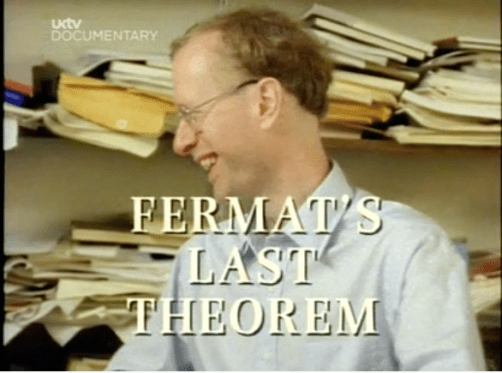
“In June 1993 he reached his goal. At a three-day lecture at Cambridge, he outlined a proof of Taniyama – and with it Fermat’s Last Theorem. Wiles’ retiring life-style was shattered. Mathematics hit the front pages of the world’s press. Then disaster struck. His colleague, Dr Nick Katz, made a tiny request for clarification. It turned into a gaping hole in the proof. As Andrew struggled to repair the damage, pressure mounted for him to release the manuscript – to give up his dream. So Andrew Wiles retired back to his attic. He shut out everything, but Fermat.”
(Click on the image to view documentary)
“This story has much to say about the nature of scientific knowledge. It is not, as we so often think, a collection of objective facts and unbiased observations that sprout in hermetically sealed environments, unsullied by human minds and hands. “On closer analysis,” writes science historian Paul Feyerabend, “we even find that science knows no ‘bare facts’ at all, but that all the ‘facts’ that enter our knowledge are already viewed in a certain way.” Facts come clothed in history, colored by context. Science is less a statement of truth than a running argument. As it turns out, the scientific method isn’t so “scientific” after all.”
Labeling emotions isn’t necessary for their primary—and immediate—purpose. “The conscious understanding of emotions is superfluous from a survival standpoint,” Gillihan says. “If I’m running away from a tiger in caveman days, I never say to myself, ‘I am afraid.’ I just think, Tiger! I’ve got to get out of here! I handle the threat and survive.” In modern times, however, our feelings often arise from our relationships, careers, and travel, and we benefit from a more considered response, he says. “It helps to be able to put a frame around more complex emotions.”
“Academic press offices are known to overhype their own research. But the University of Maryland recently took this to appalling new heights — trumpeting an incredibly shoddy study on chocolate milk and concussions that happened to benefit a corporate partner.
“It’s a cautionary tale of just how badly science can go awry as universities increasingly partner with corporations to conduct research.”
Hilmarsson said: “I don’t believe anyone believes in a one-eyed man who is riding about on a horse with eight feet. We see the stories as poetic metaphors and a manifestation of the forces of nature and human psychology.” Membership in Asatruarfelagid has tripled in Iceland to 2,400 members, out of a total population of 330,000.
The realities of speech are much more complicated than the words used to describe it.
There’s a constant conflict between social scientists and the reporters who cover them. It’s derived from “a fundamental tension between the media’s desire for novelty and the scientific method,” as Sanjay Srivastava, who researches personality at the University of Oregon, tells me.
“Our minds, cobbled together over millenniums by that lazy craftsman, evolution, are riddled with bad mental habits. We routinely procrastinate, make poor investments, waste time, fumble important decisions, avoid problems and rationalize our unproductive behaviors, like checking Facebook instead of working. These ‘‘cognitive errors’’ ripple through our lives, CFAR argues, and underpin much of our modern malaise: Because we waste time on Facebook, we end up feeling harried; when we want to eat better or get to the gym more, we don’t, but then feel frustrated and guilty.”
 TOK Topics